


Joint And Several PAYE Liability, The April 2026 Umbrella Reforms

Updated: 3 days ago

Index:
Joint and Several PAYE Liability: The April 2026 Umbrella Reforms in the UK
From 6 April 2026, recruitment agencies and end clients that use umbrella companies in their labour supply chains became jointly and severally liable for any Pay As You Earn (PAYE) tax, National Insurance Contributions (NIC), and Apprenticeship Levy that an umbrella company fails to remit to HMRC. The legislation, enacted through a new Chapter 11 of Part 2 of the Income Tax (Earnings and Pensions) Act 2003 (ITEPA), means that HMRC can pursue an agency or end client for the umbrella's payroll tax debt without first exhausting remedies against the umbrella itself, and without any requirement to show that the agency or client acted carelessly or in bad faith.
This is not a marginal change. Around 700,000 individuals work through umbrella companies in the UK, with these arrangements underpinning significant portions of the temporary staffing, IT contracting, and professional services supply chains. For any business that has historically treated umbrella company selection as an administrative or commercial decision rather than a tax governance matter, the 2026/27 tax year marks the start of genuinely new territory.
What Joint and Several Liability Actually Means in Practice
Joint and several liability means that HMRC can recover the full amount of any PAYE shortfall from any one party in the supply chain, regardless of who caused the problem or what contractual arrangements exist between the parties. Under HMRC's published guidance on PAYE rules for labour supply chains that include umbrella companies from 6 April 2026, HMRC has confirmed it will pursue the relevant party (the agency or end client) in the first instance for any PAYE shortfall, not the umbrella company.
The word "first instance" is important. HMRC is not simply creating a backstop mechanism for cases where the umbrella has disappeared or become insolvent. The intention, confirmed in HMRC's published policy paper, is to place primary collection responsibility on whoever is highest in the accessible supply chain. An agency that contracted with a non-compliant umbrella can receive an assessment from HMRC without any prior demand having been made against the umbrella company at all.
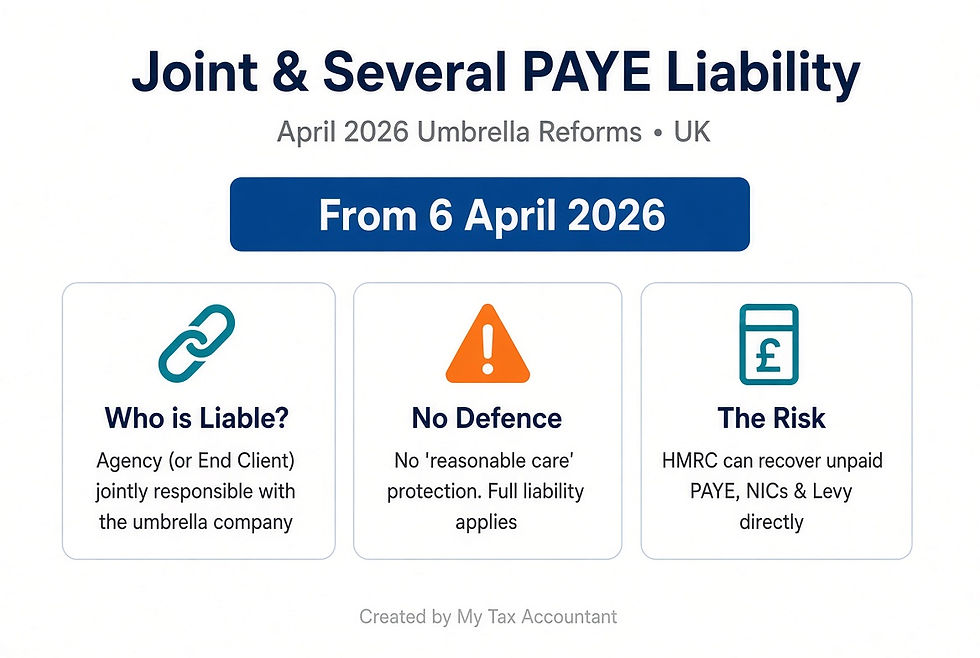
There is also no right of appeal or defence against the liability on the grounds of reasonable care. This is one of the most significant aspects of the legislation and the one that has drawn the strongest industry concern. An agency that conducted thorough due diligence, selected an umbrella holding a professional body accreditation, and received assurances that PAYE was being correctly operated can still face a liability if, in fact, the PAYE was not remitted. The fact of the shortfall, and the agency's position in the supply chain, are sufficient to create the liability. There is no statutory defence based on having acted reasonably.
Who Is the "Relevant Party" and When Does Liability Shift to the End Client?
The legislation identifies the relevant party as follows:
The recruitment agency that contracts directly with the end client is typically the relevant party. If there is no UK-resident agency in the chain, or if the end client contracts directly with the umbrella company, then the end client becomes the relevant party. Where the agency that contracts directly with the end client is connected to the umbrella company (meaning a controlled or associated arrangement), the end client becomes the relevant party. If the agency is non-UK resident and there is no other UK-resident agency closer to the end client, the end client takes the liability.
For end clients, liability is limited to PAYE shortfalls relating to work performed for that specific client. An end client is not exposed to shortfalls arising from the umbrella's work for other clients in the same arrangement. That is a meaningful limitation, but it still means that an end client's procurement of contractor services through an agency-umbrella chain creates a live tax exposure that cannot be fully transferred by contract.
Employers of Record: A Wider Scope Than Many Expect
The definition of "umbrella company" for these purposes extends to any business that employs individuals under a contract of employment and supplies their services to a third party. This brings Employers of Record (EORs) within scope. An EOR is typically used where a business wants to engage workers internationally or in sectors where it does not want to hold employer status directly. From 6 April 2026, clients using EOR arrangements face the same joint and several liability as clients using traditional umbrella structures. This is not always obvious from the commercial framing of EOR services, and it is an area where many businesses have not yet reviewed their exposure.
What this Widget is About: This interactive visual explainer, created by My Tax Accountant, breaks down the landmark April 2026 UK umbrella company reforms under Chapter 11, Part 2 of ITEPA 2003, which introduced strict joint and several liability for unremitted PAYE, NICs, and Apprenticeship Levy. It clearly illustrates how HMRC can now bypass non-compliant umbrella companies to demand immediate settlement directly from recruitment agencies or end clients with no statutory "reasonable care" defence. Users can navigate the interactive supply chain hierarchy to pinpoint exactly where legal liability lands across different contractual setups, including standard agency models, direct engagements, and Employers of Record (EOR). An integrated liability exposure calculator allows businesses to adjust contractor counts, weekly pay, Apprenticeship Levy, and multi-year timeframes to instantly project potential financial exposure and tax shortfalls. Simply use the scenario tabs, interactive due diligence checklist, and parameter sliders across the widget to assess your supply chain risks, audit current compliance processes, and protect your business from silent liabilities.

The Numbers: What a PAYE Shortfall Looks Like
To understand the financial scale at stake, it helps to run through what an umbrella PAYE failure looks like in practical terms.
An umbrella company employs 50 contractors who each earn £700 per week gross before deductions. The umbrella deducts PAYE at 20% (basic rate, simplified for illustration) and employee NIC at 8% from the earnings above relevant thresholds. Employer NIC at 15% also applies on earnings above the Secondary Threshold of £5,000 per year.
For a single contractor earning £700 per week over 48 working weeks:
Annual gross pay: £33,600. Personal allowance: £12,570. Taxable income: £21,030. Income tax at 20%: £4,206 per year. Employee NIC (on earnings above £12,570 Primary Threshold and below £50,270 Upper Earnings Limit): approximately £1,682 per year. Employer NIC (on earnings above £5,000): (£33,600 - £5,000) × 15% = £4,290 per year.
If the umbrella deducts the right amounts from the contractor's pay but does not remit them to HMRC, the total PAYE and NIC shortfall per contractor per year is approximately £10,178. Across 50 contractors, the agency or end client faces potential liability of over £500,000 for a single tax year of non-compliance.
Multiply this across a supply chain that has operated for two to three years before HMRC identifies the failure, and the numbers become very large. HMRC can assess back through the standard PAYE periods, and where careless or deliberate non-compliance is involved, the time window extends further.
This is why the change is not merely administrative. It creates a financial risk that sits silently in supply chains and can surface suddenly, many months or years after the transactions that generated it.
What Changes for Contractors Using Umbrella Companies
From a contractor's perspective, the April 2026 reforms do not directly change how their pay is calculated or taxed. The umbrella company remains their employer. PAYE is operated by the umbrella. The contractor continues to receive a payslip from which income tax and NIC have been deducted.
What changes is the accountability structure behind that payslip. The contractor is no longer entirely dependent on HMRC being able to recover from the umbrella if the umbrella fails to pass the deductions on. The liability now sits with the agency or end client as well, which increases the likelihood that the tax already withheld from the contractor's pay actually reaches HMRC.
There is a practical protection embedded here for workers. HMRC's stated policy objective includes preventing workers from receiving unexpected tax bills when umbrellas have deducted PAYE but not remitted it. The joint and several liability structure makes it easier for HMRC to collect from the agency or end client rather than pursuing individual contractors who may have had no knowledge of or involvement in the non-compliance.
HMRC has launched a tool, accessible from GOV.UK, where contractors can check whether their payslip reflects correct deductions from their umbrella company. This is a useful first step for anyone concerned about whether their umbrella is operating compliantly.
Joint And Several Paye Liability Umbrella Reforms April 2026
Reform Element | Description and Impact | Compliance Requirement |
Joint and Several Liability (JSL) | From 6 April 2026, HMRC can recover unpaid PAYE, NICs, and Apprenticeship Levy from recruitment agencies or end-clients if an umbrella company fails to remit them. This shifts tax risk up the supply chain, allowing HMRC to pursue "relevant parties" for the full shortfall. | Map the full supply chain to identify every intermediary and assess tax debt exposure. Organizations must move from passive delegation to active tax governance to ensure PAYE is properly accounted for by all partners. |
Definition of Relevant Parties | Primarily targets the "top agency" contracting with the end-client. Liability passes to the end-client if no UK agency exists, if the agency is non-resident, or if parties are "connected." The definition of "umbrella" is broad, covering Employers of Record (EOR) and "purported umbrellas." | Identify your specific position in the supply chain to understand liability ranking. Verify the residency of all participants and audit for "purported umbrellas" (e.g., payroll-only models or arrangements where workers have a material interest over 5%). |
Absence of Statutory Defenses | The legislation operates on a "strict liability" basis with no statutory defense for "reasonable care," "good faith," or being misled by fraudulent documents. Unlike IR35, completing due diligence or holding industry accreditations does not legally extinguish the debt transfer. | Recognize that due diligence only influences HMRC’s enforcement discretion and does not provide a legal shield. Organizations must focus on evidence-based decision-making and active risk management rather than relying on third-party badges. |
Due Diligence and Auditing | HMRC expects a shift from "trust-based" business to "real-time verification." This includes auditing payroll records, monitoring RTI submissions, and checking financial stability (net assets/credit) to prevent exposure to non-compliant or insolvent entities. | Implement a "check, act, and review" framework. Obtain real-time evidence of actual HMRC remittance (PAYE reference numbers) rather than just deduction certificates. Document all governance decisions to serve as evidence for future audits. |
Contractual and Operational Controls | JSL necessitates restructuring contracts to manage risk. This includes enforcing Preferred Supplier Lists (PSLs), obtaining audit rights, and securing indemnities, though these do not override the statutory liability to HMRC. | Update umbrella agreements to include explicit PAYE/NIC compliance warranties, unhindered audit rights, and immediate termination clauses. Consider risk mitigation models such as direct PAYE remittance or using real-time payroll auditing platforms. |
What Agencies and End Clients Must Now Do Differently
The legislation explicitly creates an expectation of active oversight. Contractual protections, indemnity clauses, and warranties do not prevent HMRC from pursuing a relevant party. They may give the agency a contractual claim against the umbrella after the fact, but that right is only valuable if the umbrella has assets to satisfy the claim, which non-compliant umbrellas often do not.
The practical steps that agencies and end clients need to take in 2026/27 include:
Mapping the supply chain in full. Every route through which contracted workers reach the business needs to be identified, including routes that may involve a mix of agency, sub-agency, and umbrella layers.
Obtaining evidence of PAYE compliance from the umbrella, not just accreditation certificates. Industry accreditations (such as those from FCSA or Professional Passport) are useful indicators but HMRC has explicitly stated they are insufficient on their own. What is needed is evidence of actual PAYE compliance: Real Time Information (RTI) submission confirmations, HMRC reference numbers for the umbrella's PAYE scheme, and payslip reconciliations that demonstrate deductions are being operated correctly.
Building contractual rights to audit the umbrella's compliance and receive PAYE confirmation on a regular basis. Contracts entered before April 2026 may not include these rights and should be reviewed.
Keeping contemporaneous records of the due diligence undertaken and the results. While there is no statutory defence based on reasonable care, demonstrating a structured compliance process is relevant in any subsequent negotiations with HMRC and in any recovery action against the umbrella under indemnity clauses.
What this Widget is About: This interactive visual explainer clearly breaks down the Joint and Several PAYE Liability rules that took effect on 6 April 2026, showing how recruitment agencies and end clients can now be held fully responsible for any unpaid PAYE, National Insurance and Apprenticeship Levy when an umbrella company fails to remit the correct amounts to HMRC. It walks UK taxpayers, agencies and businesses through who counts as the “relevant party,” the absence of a reasonable-care defence, the inclusion of Employers of Record, and the practical financial scale of potential shortfalls. Users simply click the colour-coded tabs at the top—Overview, Who is Liable?, The Numbers, What To Do, For Contractors and Key Takeaways—to move between concise, easy-to-read sections. An interactive calculator lets you estimate exposure for multiple contractors, while expandable accordions and supply-chain diagrams illustrate liability pathways at a glance. Created by My Tax Accountant, the widget is fully responsive, designed for a Wix HTML box, and gives clear, actionable guidance without requiring prior tax expertise.
The 2027 Umbrella Regulation: A Separate But Connected Development
The April 2026 changes are tax measures only. They do not introduce licensing or regulation of umbrella companies as businesses. That step is expected to follow in 2027, when umbrella companies will be regulated alongside recruitment agencies under the Employment Agency Standards regime, with oversight transitioning to the Fair Work Agency (FWA) that was established in April 2026. As set out in the GOV.UK guidance on the Fair Work Agency's remit and responsibilities, the FWA will take on enforcement of employment rights including National Minimum Wage, holiday pay, and agency worker rights in the supply chain.
The 2027 regulation will likely require umbrellas to meet minimum standards as a condition of operating in the market. Until then, the April 2026 joint and several liability regime operates as the primary mechanism for tackling non-compliance, by making it financially unattractive for agencies and end clients to work with umbrellas that cannot demonstrate clean PAYE compliance.

Scottish and Welsh Workers: Position Under the 2026 Rules
The joint and several PAYE liability legislation applies UK-wide. PAYE obligations are a reserved matter, unaffected by devolution.
For Scottish workers employed through an umbrella, income tax is collected at Scottish rates under the Scottish rate of income tax (SRIT) framework. The umbrella must apply the appropriate Scottish tax code (S prefix) where the worker holds Scottish residence. If an umbrella applies UK-wide basic rate tax codes to a Scottish worker who should be taxed at Scottish intermediate rate (21%), the resulting PAYE shortfall is still an umbrella PAYE failure and falls within the joint and several liability regime. The agency or end client can therefore face liability not only for complete non-remittance but also for systematic under-deduction of tax arising from incorrect code application.
Welsh income tax rates for 2026/27 are set at equivalent levels to England, so the Scottish distinction does not apply to Welsh-resident workers.
Key Takeaways
The joint and several PAYE liability for umbrella company workers applies from 6 April 2026 under new Chapter 11 of Part 2 ITEPA 2003. The regime covers income tax, National Insurance Contributions, and Apprenticeship Levy.
HMRC will pursue the recruitment agency or end client in the first instance, not the umbrella company, for any payroll tax shortfall. There is no defence based on reasonable care or on having followed the umbrella's assurances.
The relevant party is usually the recruitment agency contracting directly with the end client. End clients become relevant parties where the agency is connected to the umbrella company, where the agency is non-UK resident, or where the end client contracts directly with the umbrella.
Employers of Record (EORs) fall within the definition of umbrella company for these purposes. Clients using EOR arrangements are within scope.
Industry accreditations are not sufficient evidence of PAYE compliance. Agencies and end clients need contractual rights to receive actual PAYE evidence, RTI confirmation, and payslip reconciliation data from their umbrella partners.
Full umbrella sector regulation under the Employment Agency Standards framework is expected to follow in 2027. The April 2026 changes are tax compliance measures operating in advance of that.
FAQS
What is joint and several PAYE liability for umbrella companies?
From 6 April 2026, recruitment agencies and end clients that use umbrella companies in their labour supply chains share liability with the umbrella for any PAYE, NIC, and Apprenticeship Levy the umbrella fails to pay HMRC. HMRC can recover the full amount from the agency or end client without first pursuing the umbrella, and without needing to show the agency or client was at fault.
Who is the relevant party under the April 2026 umbrella rules?
The relevant party is usually the recruitment agency that contracts directly with the end client. If the agency is connected to the umbrella company, is non-UK resident, or if the end client contracts directly with the umbrella, the end client becomes the relevant party jointly liable for any PAYE shortfall.
Does the April 2026 change affect contractors directly?
The contractor's pay and deductions are calculated as before. The umbrella remains the employer and operates PAYE on the contractor's pay. The change affects the agency and end client, not the contractor, by making them jointly liable for any PAYE the umbrella fails to remit.
Is there a defence if an agency checked the umbrella's accreditation?
No. There is no statutory defence against joint and several liability based on having conducted due diligence or relied on industry accreditation. HMRC has confirmed that accreditations are insufficient on their own. Agencies need actual PAYE compliance evidence, not just certificates.
Do employers of record (EORs) fall within the April 2026 umbrella rules?
Yes. Any business that employs individuals under a contract of employment and supplies their services to a third party falls within the definition of umbrella company for these purposes. Clients using EOR arrangements face the same joint and several liability as those using traditional umbrella structures.
When does umbrella company licensing or regulation start?
The April 2026 changes are tax measures only. Full licensing and regulation of umbrella companies under the Employment Agency Standards framework is expected to follow in 2027, with oversight by the Fair Work Agency.
What should an agency do now to protect itself from liability?
An agency should map all supply chains involving umbrella companies, obtain ongoing PAYE compliance evidence (including RTI confirmation and payslip reconciliation data) rather than relying on accreditation, build contractual audit rights into umbrella agreements, and maintain records of all due diligence conducted.
Can an agency recover from the umbrella if HMRC pursues the agency?
Contractually, an agency may have an indemnity or warranty from the umbrella. However, HMRC's recovery from the agency is not contingent on that contractual right being exercised or enforceable. Non-compliant umbrellas frequently have insufficient assets to satisfy recovery claims, which is why the joint and several liability regime was introduced in the first place.
Does the April 2026 umbrella reform apply differently in Scotland?
The reform applies UK-wide. For Scottish workers, the umbrella must apply Scottish tax codes (S prefix) and deduct at Scottish income tax rates. A failure to apply the correct Scottish rates is still a PAYE shortfall that falls within the joint and several liability regime, creating exposure for the agency or end client.
About the Author

Maz Zaheer, AFA, MAAT, MBA, is the CEO and Chief Accountant of MTA and Total Tax Accountants, two premier UK tax advisory firms. With over 15 years of expertise in UK taxation, Maz provides authoritative guidance to individuals, SMEs, and corporations on complex tax issues. As a Tax Accountant and an accomplished tax writer, he is renowned for breaking down intricate tax concepts into clear, accessible content. His insights equip UK taxpayers with the knowledge and confidence to manage their financial obligations effectively.
Disclaimer:
The information provided in our articles is for general informational purposes only and is not intended as professional advice. While we strive to keep the information up-to-date and correct, MTA makes no representations or warranties of any kind, express or implied, about the completeness, accuracy, reliability, suitability, or availability with respect to the website or the information, products, services, or related graphics contained in the articles for any purpose. Any reliance you place on such information is therefore strictly at your own risk. The graphs may also not be 100% reliable.

