


Capital Allowances For Sole Traders Buying A Van In 2026/27

Capital Allowances for Sole Traders Buying a Van in 2026/27
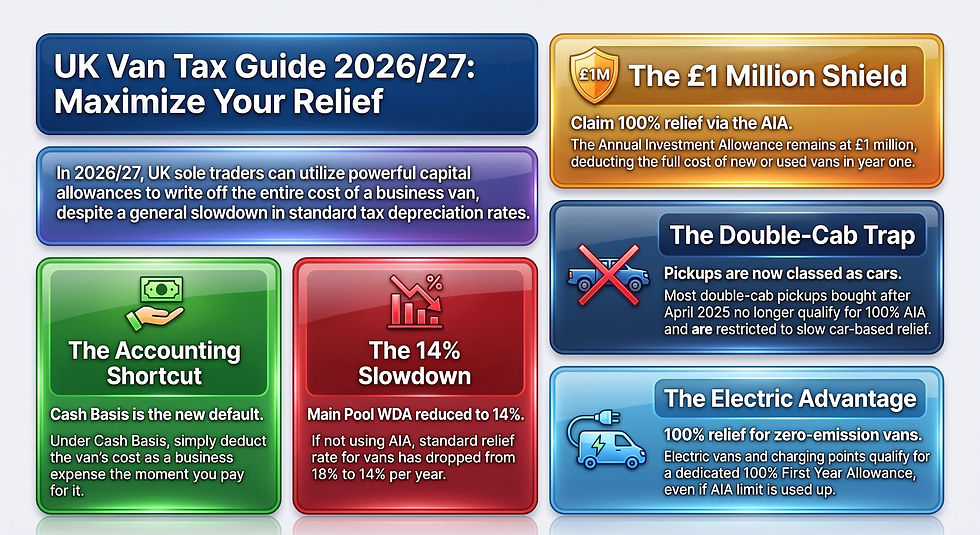
A sole trader buying a van for business use in 2026/27 can claim the full cost as a deduction against taxable profits in the year of purchase through the Annual Investment Allowance, provided the van is used wholly or mainly for business and is genuinely a van rather than a car. The AIA limit for 2026/27 is £1 million, which covers virtually any van purchase a sole trader is likely to make.
Why a Van Gets Better Tax Treatment Than a Car
The distinction between a van and a car is one of the most practically important classifications in UK capital allowances, and it is worth being precise about it.
A car for capital allowances purposes is a vehicle of a type primarily suited to carrying passengers. Cars do not qualify for the Annual Investment Allowance and must be claimed through the writing-down allowance at either 18% or 6% per year depending on CO2 emissions. A van is a goods vehicle not designed primarily to carry passengers, and qualifies for the AIA in the same way as other plant and machinery.
This matters enormously in practice. A car with a purchase price of £25,000 and emissions above 50g/km goes into the special rate pool at 6% per year. In year one you claim £1,500. The van, at the same price, qualifies for the AIA and produces a full £25,000 deduction in year one.
The tax saving on the van in year one, for a sole trader paying income tax at 40%, is £10,000. On the car under the 6% pool, it is £600 in the first year. This is not a small difference.
Where the Car/Van Line Gets Blurry
Double-cab pickup trucks with a payload of one tonne or more have historically been treated as vans for capital allowances (and as goods vehicles for benefit-in-kind purposes). There is a specific complication here: HMRC updated its guidance on the employment tax treatment of double-cabs following the Court of Appeal decision in Payne v HMRC [2020]. For 2026/27, HMRC's position is that double-cab pickups capable of carrying passengers in the rear seats are treated as cars for company car tax purposes.
For capital allowances, the position has been more favourable, but care is needed. If you are buying a double-cab pickup and your bookkeeper is treating it as a van for capital allowances, confirm the payload and the specific model's classification before claiming the AIA. Getting this wrong can result in a compliance check and adjustment.
Genuine panel vans, Luton vans, flatbed trucks, transit-style cargo vans, and similar vehicles with no passenger seating beyond the cab are unambiguously vans and qualify for AIA without question.
How the Annual Investment Allowance Works for a Van Purchase
The Annual Investment Allowance provides 100% tax relief on the cost of qualifying plant and machinery in the accounting period in which the expenditure is incurred. The AIA limit is £1 million per year for both companies and unincorporated businesses. For a sole trader with a tax year ending 5 April, the limit applies to expenditure incurred in the tax year from 6 April 2026 to 5 April 2027.
For a sole trader buying a £28,000 van in October 2026, the AIA deduction is £28,000. This reduces taxable trading profit by £28,000 in the 2026/27 tax year. The tax saved is £28,000 multiplied by the marginal income tax rate applicable to that trader.
For a basic rate taxpayer (income between £12,570 and £50,270): tax saving of approximately £5,600 at 20%, plus Class 4 NIC saving of approximately £2,520 at 9%.
For a higher rate taxpayer (income above £50,270): income tax saving of £11,200 at 40%, plus Class 4 NIC saving at 2% on income above the upper profits limit.
The AIA claim is made on the self-employment pages of the Self Assessment return, and specifically on the capital allowances section. It is not a separate claim outside the return.
What About a Second-Hand Van?
The AIA applies equally to second-hand vehicles, provided they qualify as vans and the vendor is not a connected person. A sole trader buying a used Ford Transit from a dealership or a private seller has the same AIA entitlement as one buying new. The only restriction on used assets is where the purchase is from a connected party (such as your own limited company or a close family member), in which case the AIA cannot be claimed.
Private Use and the Adjustments Required
This is where most errors occur. The AIA is not automatically available in full just because a van has been purchased. Where there is private use, the AIA must be adjusted.
Where a sole trader uses a van for both business and private purposes, the capital allowances claim is restricted to the business-use proportion. A sole trader who uses a van 70% for business and 30% for private use can claim 70% of the AIA on the van's cost.
For a £28,000 van with 70% business use, the AIA claim is £19,600. The remaining £8,400 is not eligible for any capital allowances.
What counts as private use? Using the van to visit friends or family, drive to personal appointments, go on holiday, or transport personal goods are all private use. Commuting from home to a regular fixed workplace is also private use under HMRC's interpretation, though this rarely affects tradespeople whose first stop each morning is a job site rather than a single fixed base.
Most sole traders who use a van for their trade have very little genuine private use. A gas engineer who travels between jobs all day and parks the van on the driveway overnight is using it primarily for business. HMRC does not typically challenge a 90% or 95% business use claim where the facts support it. The key is to have a genuine, considered estimate and to document it.
The private use restriction applies to capital allowances only. For running costs (fuel, insurance, repairs, servicing), you either claim actual costs adjusted for business use proportion, or you use HMRC's simplified mileage rates instead. You cannot use mileage rates and separately claim capital allowances. Choosing which method to use for running costs must be made consistently and declared on the return.
The Alternative: Using the Mileage Allowance Instead
Some sole traders prefer to claim the HMRC flat-rate mileage allowance rather than capital allowances and actual running costs. The approved mileage rate for 2026/27 is 45p per mile for the first 10,000 business miles and 25p per mile beyond that.
If a sole trader drives 15,000 business miles in the tax year, the mileage deduction is: (10,000 × 45p) + (5,000 × 25p) = £4,500 + £1,250 = £5,750. No capital allowances are claimed, and no running costs are claimed separately.
For a newly purchased van, the mileage method typically produces a smaller deduction in the early years compared to an AIA claim, because the AIA front-loads the full capital cost as an immediate deduction. A £28,000 van claimed under AIA produces a £28,000 deduction in year one. The same van under the mileage method would take several years to reach an equivalent deduction through mileage alone.
There are situations where the mileage method wins. If the van was bought several years ago and is now fully depreciated for capital allowance purposes (its tax written-down value is near zero), switching to mileage may not be possible (you cannot switch once actual costs have been used), and the capital allowance deduction in later years is minimal anyway. But for a new purchase in 2026/27, the AIA almost always produces a better first-year result if mileage is less than roughly £62,000 worth of allowances.
Once a sole trader chooses the actual expenses method (including capital allowances) for a particular vehicle, they must continue to use that method for that vehicle throughout its business life. Switching from actual costs to mileage rates mid-ownership is not permitted.
This is an important point: make the decision before you claim anything on the vehicle, because it locks you in.
What Happens When You Sell the Van
When a van on which AIA has been claimed is eventually sold, a balancing charge can arise.
Where a van was fully claimed under the AIA and is later sold, the disposal proceeds are a taxable receipt called a balancing charge. If the van was bought for £28,000 and fully claimed, and is later sold for £12,000, the £12,000 disposal proceeds are added back to taxable profits in the year of sale.
This is not a penalty. It is simply the system ensuring that the net relief given over the life of the asset equals its actual cost (purchase price minus disposal proceeds). If you claim £28,000 upfront and later sell for £12,000, you have received £16,000 of net relief, which is exactly the economic cost of using the van.
The balancing charge of £12,000 in the year of sale increases taxable profit. For a higher rate taxpayer, that is £4,800 of income tax plus Class 4 NIC at 2% on the disposal value. This can catch sole traders off guard when they replace a vehicle, because the proceeds from selling the old van add to taxable income in the same year they may also be claiming AIA on the new one.
Where the private use adjustment applied on the original claim, the disposal proceeds are also adjusted proportionally. If 70% business use was claimed, 70% of the disposal proceeds become a taxable balancing charge.
Zero-Emission Vans: The 100% First-Year Allowance
Zero-emission goods vehicles attract a 100% first-year allowance as a separate relief from the AIA. A zero-emission van purchased in 2026/27 qualifies for a 100% first-year allowance, allowing the full purchase cost to be deducted in the year of acquisition regardless of whether the AIA limit has been used on other purchases.
For a sole trader who has already spent their full AIA on other equipment in the year, a zero-emission van still gets 100% relief through this separate allowance. This makes electric vans particularly tax-efficient for sole traders who invest heavily in tools and equipment alongside vehicles.
The qualifying condition is that the van is genuinely zero-emission, which means electric. Hybrid vans do not qualify for this allowance. Hydrogen fuel cell vans may qualify, but the market for those in the commercial vehicle sector remains limited.
Van Finance: Hire Purchase, Lease, and Outright Purchase
How you pay for the van affects which capital allowances you can claim and when.
Outright purchase: the AIA is claimed in the year of purchase, as described throughout this article.
Hire purchase: HMRC treats hire purchase as equivalent to outright purchase for capital allowances purposes. Where a sole trader acquires a van under a hire purchase agreement, the full capital cost of the van (not the monthly payments) is treated as incurred on the date the HP agreement is entered into. The AIA can therefore be claimed in full in the year the HP contract is signed, not spread across the repayment period.
This is one of the more counterintuitive rules. A sole trader who signs an HP agreement for a £30,000 van in April 2026, with repayments over three years, claims the full £30,000 AIA in the 2026/27 tax year. The interest element of the HP payments is then claimed as a revenue expense as it accrues.
Finance lease: where a van is financed through a finance lease rather than HP, the legal ownership does not transfer to the trader. The capital allowances treatment depends on the nature of the lease. A finance lease that substantially transfers the risks and rewards of ownership may still permit capital allowances, but this requires a careful look at the lease terms. Short-term operating leases, where the van is simply hired, do not give rise to a capital allowances claim. Instead, the lease rental payments are deductible as revenue expenses.
If you are not certain which category your finance arrangement falls into, look at whether you have an option to purchase the van at the end of the agreement. Hire purchase agreements always have this; operating leases typically do not.
A Worked Example
A self-employed plumber buys a new Ford Transit van in September 2026 for £32,000, financed through hire purchase. He uses the van 85% for business. His trading profits before the van deduction are £68,000 for 2026/27. He is not claiming any other capital allowances in the year.
AIA claim: £32,000 × 85% business use = £27,200.
Adjusted trading profit: £68,000 minus £27,200 = £40,800.
Income tax on £40,800 (after personal allowance of £12,570): £28,230 taxable at 20% basic rate = £5,646.
Class 4 NIC: profits between £12,570 and £40,800 = £28,230 at 9% = £2,541.
Without the van deduction, trading profits of £68,000 would have produced: Income tax: £55,430 taxable, split into £37,700 at 20% (£7,540) and £17,730 at 40% (£7,092) = £14,632. Class 4 NIC: £37,700 at 9% = £3,393, plus £5,730 (excess over £50,270) at 2% = £115. Total NIC = £3,508.
Total tax without the van claim: £18,140. Total tax with the van claim: £8,187.
Tax saved by the AIA claim: approximately £9,953 in the 2026/27 tax year.
He will have a balancing charge to consider when he eventually sells the van, based on 85% of the disposal proceeds at that time.
Scottish Taxpayers: The Rate Interaction
The AIA deduction reduces taxable trading profit. For Scottish sole traders, that reduction is valued at Scottish income tax rates on the portion of profit saved.
Scottish income tax rates for 2026/27 apply an Intermediate rate of 21% on income between approximately £14,876 and £26,561, a Higher rate of 42% between £43,662 and £75,000, and an Advanced rate of 45% between £75,001 and £125,140. These are higher than the equivalent UK rates for most bands above the basic rate.
A Scottish sole trader whose profits fall in the 42% Scottish Higher rate band therefore values a £27,200 AIA deduction at £11,424 in income tax saving (42%), compared to £10,880 for an English higher rate taxpayer (40%). The Class 4 NIC saving is the same regardless of where you live, as NIC is a reserved UK-wide matter.

Key Takeaways
A van purchased for business use by a sole trader in 2026/27 qualifies for the Annual Investment Allowance at up to 100% of the cost, provided it is genuinely a goods vehicle and not a car. The AIA limit is £1 million.
The claim must be restricted for private use. Only the business-use proportion of the van's cost is eligible.
Hire purchase agreements allow the full AIA claim in the year the agreement is entered into, not spread over the repayment period.
Zero-emission vans attract a separate 100% first-year allowance even where the AIA has been fully used on other purchases.
When the van is sold, the disposal proceeds trigger a balancing charge equal to the business-use proportion of those proceeds. This adds back to taxable profit in the year of sale.
Once the actual expenses method (including capital allowances) is chosen for a van, it cannot be switched to the mileage method mid-ownership.
FAQs
Q1: What happens if a sole trader buys a van partly for personal use, how do you accurately apportion the capital allowances?
Well, it's worth noting that this is one of the most common pitfalls I see with clients who are tradespeople or delivery drivers. You can only claim capital allowances on the business-use portion of the van. For example, if your records show 70% business mileage based on a detailed logbook (keeping a sample week each quarter often suffices for HMRC), then you claim 70% of the Annual Investment Allowance or writing down allowances. In my experience with a plumber in Manchester, failing to maintain consistent records led to a query from HMRC that was easily resolved once he produced his mileage diary, but it caused unnecessary stress. Always base it on actual use rather than a rough estimate to avoid adjustments or penalties.
Q2: Can sole traders still benefit from enhanced allowances on electric or zero-emission vans in 2026/27, and what records make claiming straightforward?
In my practice, many self-employed clients switching to electric vans for lower running costs are pleasantly surprised by the tax perks. New zero-emission vans often qualify for 100% first-year allowances in addition to the AIA framework. Consider a courier in Bristol who bought a new electric van mid-year: by claiming the full qualifying amount against profits, he significantly reduced his tax bill while enjoying cheaper fuel and maintenance. Keep evidence of the vehicle's emissions rating from the manufacturer and your purchase invoice, it's a small effort that delivers big value and stands up well if reviewed.
Q3: What are the tax implications if a sole trader sells their van after claiming full capital allowances under the AIA?
This is a classic edge case that catches people out. If you've claimed 100% relief via the Annual Investment Allowance and then sell the van, you may face a balancing charge where the sale proceeds are added back to your taxable profits. I've advised a builder near Birmingham who sold his van after two years for a good price, the charge reduced his initial tax saving but still left him better off overall than depreciating slowly. Track the disposal carefully on your Self Assessment and consider timing the sale to manage cash flow across tax years.
Q4: How does using the cash basis accounting affect capital allowances when a sole trader purchases a van?
It's a common mix-up for newer sole traders. Under cash basis, you generally can't claim capital allowances on most assets like vans in the usual way, instead, you might expense the cost directly if it qualifies, but vans often push you towards traditional accounting for full flexibility. One client, a mobile hairdresser in Leeds, switched to accruals basis specifically to maximise her van claim and saw immediate benefits. Review your turnover and overall setup with your accountant to decide what's optimal, as it can influence not just the van but your entire tax position.
Q5: Are there any special considerations for sole traders buying a van on hire purchase or finance in 2026/27?
From advising many business owners, finance arrangements add a layer worth getting right. You can typically claim capital allowances on the full cost as if purchased outright, while deducting the interest element as a revenue expense. A landscape gardener I worked with in Scotland used HP for his new van and maximised the AIA claim upfront, easing his cash flow. Ensure the agreement is structured as hire purchase (where you own it eventually) rather than pure leasing, and keep all statements to separate capital and interest clearly.
Q6: What if a sole trader already has other capital expenditure, does buying a van risk exceeding the Annual Investment Allowance limit?
The £1 million AIA limit is generous for most sole traders, but high spenders on equipment or fixtures need to watch the total. In practice, I've seen a construction contractor in Cardiff who bundled his van purchase with new tools and still stayed well under, the key is planning your investments within the tax year. If you exceed it, the excess goes into the main pool for 18% writing down allowances. Prioritise high-value items like the van for full relief where possible.
Q7: Can sole traders claim capital allowances on a second-hand van, and are there any traps compared to buying new?
Absolutely, second-hand vans qualify for the AIA in most cases, which is great news for cost-conscious self-employed folk. However, the relief is still 100% in the year of purchase up to the limit, unlike some restrictions on other assets. A delivery driver client from London bought a reliable used van and claimed fully, but we had to confirm it hadn't been used previously in a way that affected eligibility. Always get a clear invoice showing the purchase price and business intent from day one to avoid any HMRC scrutiny.
Q8: How do capital allowances for vans interact with simplified mileage expenses for sole traders?
You generally can't mix claiming capital allowances on the van purchase with the flat-rate mileage allowance for the same vehicle, it's one or the other. Many of my clients, especially those with lower mileage, prefer capital allowances for the big upfront deduction plus actual running costs (apportioned). A freelance photographer in Edinburgh found this combination worked better for her variable schedule. Choose based on your annual mileage and keep meticulous records to support whichever method you pick.
Q9: What happens to capital allowances on a van if a sole trader's business circumstances change, like going dormant or switching to a limited company?
This is an important variation for growing businesses. If you cease trading, you may get a balancing allowance or face a charge on the van's value. Transitioning to a limited company often requires careful handling to transfer assets without losing relief. I've guided several clients through this, one market trader in Wales timed his incorporation around the van claim to minimise disruption. Always plan ahead and document the change thoroughly for a smooth HMRC process.
Q10: For sole traders with multiple income sources, how should capital allowances on a van be allocated if the vehicle supports different activities?
In cases with side hustles or mixed trades, you apportion based on the primary qualifying business use. A client running both a plumbing business and occasional eBay sales allocated the van mostly to the trade, claiming accordingly and keeping separate logs. This prevents over-claiming while maximising legitimate relief. Review your overall Self Assessment holistically, as it ties into your total profits and tax bands, getting this right can free up cash for reinvestment.
About the Author

Maz Zaheer, AFA, MAAT, MBA, is the CEO and Chief Accountant of MTA and Total Tax Accountants, two premier UK tax advisory firms. With over 15 years of expertise in UK taxation, Maz provides authoritative guidance to individuals, SMEs, and corporations on complex tax issues. As a Tax Accountant and an accomplished tax writer, he is renowned for breaking down intricate tax concepts into clear, accessible content. His insights equip UK taxpayers with the knowledge and confidence to manage their financial obligations effectively.
Disclaimer:
The information provided in our articles is for general informational purposes only and is not intended as professional advice. While we strive to keep the information up-to-date and correct, MTA makes no representations or warranties of any kind, express or implied, about the completeness, accuracy, reliability, suitability, or availability with respect to the website or the information, products, services, or related graphics contained in the articles for any purpose. Any reliance you place on such information is therefore strictly at your own risk. The graphs may also not be 100% reliable.

