


How to Check Your CIS Status?

Updated: Aug 5, 2025

Understanding Your CIS Status: The Essentials for UK Construction Workers and Businesses
Picture this: You're a busy subcontractor wrapping up a job on a rainy site in Manchester, and as you glance at your latest payment slip, something doesn't add up – the deductions seem steeper than expected. None of us loves those nagging doubts about tax, especially in the construction world where cash flow is king. But here's the good news: checking your CIS status in the UK is simpler than it sounds, and it can save you from overpaying or facing surprises come tax time. As a chartered accountant with over 15 years advising folks just like you – from sole traders in the building trade to larger contractors across London and beyond – I've seen how a quick status check can turn potential headaches into straightforward refunds.
Let's get straight to it. Your CIS status refers to your registration under the Construction Industry Scheme, which determines how much tax is deducted at source from your payments if you're a subcontractor, or your obligations if you're a contractor. According to HMRC's latest figures, around 1.5 million people operate under CIS, with average overpayments hitting £800 per year for those who don't verify their details regularly – often due to mismatched registration or unreported changes. For the 2025/26 tax year, the scheme remains crucial, with no major rate changes but new tweaks like expanded coverage for traffic management services from March 2025 and stricter VAT checks for gross payment status. If you're unregistered as a subcontractor, expect 30% deductions; registered, it's 20%; and if you've earned gross payment status, zilch – but more on that later.
First off, why bother checking? Well, in my experience, clients trip up here all the time. Take one builder I advised last year – he'd switched from sole trader to limited company but forgot to update his CIS, leading to unnecessary 30% hits on his invoices. By verifying his status online, we reclaimed over £2,000. It's not just about refunds; it's ensuring your final tax bill aligns with your actual liability, especially with personal allowances frozen at £12,570 until 2028 and inflation nibbling at your real income.
What Exactly Is CIS and Who Needs to Worry About It?
So, the big question on your mind might be: Does this even apply to me? CIS kicks in for most construction work in the UK – think building, alterations, repairs, decorating, or civil engineering like roads and bridges. It doesn't cover pure material supplies or non-construction site jobs, like running a canteen. If you're a subcontractor getting paid by a contractor, deductions happen at source as advance payments towards your income tax and National Insurance. Contractors, you're the ones making those deductions and reporting to HMRC.
Be careful here, because I've seen clients in similar boats get caught out. If your business spends over £3 million on construction in a year (a threshold updated recently), you must register as a contractor even if that's not your main gig. Subcontractors aren't forced to register, but skipping it means higher 30% deductions – a real sting for cash flow. And if you're based abroad but working on UK sites? Same rules apply.
For the 2025/26 tax year, deduction rates stay steady:
CIS Deduction Rates | Description | Rate |
Gross Payment Status | For compliant, high-turnover subcontractors – no deductions at source. | 0% |
Standard Registered | Most subcontractors who've registered with HMRC. | 20% |
Unregistered | If you haven't signed up, or verification fails. | 30% |
This table doesn't just list rates; consider the implications – with inflation at around 2.5% in mid-2025, that 30% hit feels even heavier on your net take-home. HMRC's guidance stresses these are advances, so over-deductions can be reclaimed via Self Assessment, but why wait when a status check prevents it?
Step-by-Step: How to Check If You're Registered for CIS
Now, let's think about your situation – if you're a subcontractor staring at payslips, or a contractor onboarding new hands. The quickest way is through your HMRC personal tax account or business tax account. Don't have one? Sign up via GOV.UK log-in-register-hmrc-online-services – it takes minutes with your National Insurance number and email.
Here's a practical guide I've walked countless clients through:
Log In Online: Head to the HMRC site and sign in. If you're new, you'll need your Unique Taxpayer Reference (UTR) – that's your 10-digit tax ID, found on old tax returns or by calling HMRC's helpline (0300 200 3210, open weekdays).
Navigate to CIS Section: Under 'Your Income Tax' or 'Manage CIS', click to view your status. It'll show if you're registered, your deduction rate, and any gross payment approval.
Verify Details: Check your name, UTR, and business type match. If it's blank or says 'unregistered', act fast – register right there online.
Review Payments: For subcontractors, scroll to 'CIS deductions' to see year-to-date figures. Contractors, use the 'Verify subcontractor' tool to check your team's status.
Cross-Check with Statements: Grab your payment and deduction statements (PDS) from contractors – they must provide these monthly. If missing, chase them or request HMRC duplicates by post (allow 15 days).
In rare cases, like if you've been hit with emergency tax (say, 30% because a contractor couldn't verify you quickly), this check reveals it instantly. One client of mine, a plumber in Leeds, discovered an old unregistered status from a side job years ago – we fixed it and got a £1,200 refund.
Registering for CIS: Don't Leave It to Chance
If your check shows you're not registered, or you're starting out, get on it pronto. Subcontractors: Use form CIS302 online or post it with your UTR and NI number. Contractors: Follow the new employer setup, adding CIS to your PAYE account. It typically takes 2-4 weeks for confirmation, but you can backdate if needed.
Here's a quick checklist I've crafted for my clients – print it out and tick as you go:
Gather UTR, NI, business name/address.
Decide: Subcontractor, contractor, or both?
Register online via HMRC portal.
Note your verification reference.
Inform contractors of your new status to adjust deductions.
For business owners, remember: From April 2025, if your spend hits £3m, mandatory registration – I've advised firms who overlooked this and faced penalties up to £3,000.
Common Pitfalls and How to Spot Them Early
Be careful here, because I've seen clients trip up when assuming their status is static. Life changes – like incorporating your business or moving to Scotland – can affect it. Scottish taxpayers face different income tax bands (more on that later), but CIS deductions remain UK-wide at 20/30%. If your status looks off, say deductions don't match your registration, contact HMRC immediately. Unreported side hustles, like a bit of freelance fitting alongside CIS work, can lead to underpayments too – always declare multiple incomes in Self Assessment.
Take Sarah from Manchester, a hypothetical but all-too-real case based on patterns I've seen: As a registered subcontractor earning £40,000 gross, she should see 20% (£8,000) deducted. But an admin error left her at 30% (£12,000), overpaying £4,000. A quick status check via her personal tax account flagged it, and we reclaimed via her tax return.
Tailored Advice for Employees vs. Self-Employed in CIS
If you're employed (PAYE) but dabble in CIS subcontracting, it's a minefield – those side earnings count as self-employment, triggering Self Assessment. Check your CIS status separately from your tax code. For pure self-employed, your status directly impacts cash flow; verify quarterly to catch issues.
In my years advising clients in London, one pattern stands out: Over-65s often miss marriage allowance transfers, which can boost your personal allowance by £1,260. If you're in that boat under CIS, factor it in when checking overpayments.
Verifying CIS Deductions and Calculating Your Tax Liability in the UK
None of us loves tax surprises, but here's how to avoid them – especially when your CIS deductions feed into your overall income tax picture. Building on those initial checks, let's dive deeper into verifying what you've actually paid versus what you owe. In my practice, I've helped dozens of subcontractors spot mismatches that led to hefty refunds, often because they hadn't crunched the numbers properly. For the 2025/26 tax year, with the personal allowance still stuck at £12,570 and basic rate tax at 20% up to £50,270 in England and Northern Ireland, those CIS deductions – typically 20% for registered folks – act as a down payment on your final bill. But get this: If your total income pushes you into higher bands, or if you've got multiple gigs, things can shift quickly.
According to HMRC's guidance, CIS deductions are advances towards your income tax and Class 4 National Insurance, so over-deductions happen more than you'd think – particularly with variable site work or side jobs. Recent stats don't pin an exact average overpayment for 2025, but from patterns in refund claims, it's not uncommon to see £500-£1,000 clawed back if you've been hit at 30% unnecessarily. And with inflation hovering around 2-3%, that extra cash matters. Let's break it down with real-world calculations, tailored for your setup.
How to Calculate Your Net CIS Deductions Manually
Picture this: You're a self-employed bricklayer pulling in £45,000 gross from CIS contracts this year. At 20% deduction, that's £9,000 held back – but is it spot on? Manual checks are gold when your online account lags or you're juggling papers. Start with your payment statements – contractors must issue these monthly, showing gross payment, materials cost (if deducted), and tax withheld.
Here's a step-by-step I've refined over years advising tradespeople:
Tally Gross Earnings: Add up all CIS payments before deductions. Exclude non-CIS income for now.
Apply Deduction Rate: Multiply by your rate – 20% if registered, 30% if not. For gross status? Zero, but verify compliance first.
Subtract from Total Income: Feed this into your overall tax calc, remembering CIS covers tax and NI.
Factor Personal Allowance: Deduct £12,570 (or less if over £100,000 income).
Apply Bands: What's left gets taxed at 20%, 40%, or 45%.
Take a simple table to illustrate – I've put together this original example based on common client scenarios for 2025/26:
Income Bracket | Tax Rate | Example Calculation (Gross £45,000, 20% CIS Deducted) |
Personal Allowance (£0 - £12,570) | 0% | No tax on first £12,570. Net after CIS: £36,000 (45k - 9k deducted). |
Basic Rate (£12,571 - £50,270) | 20% | Tax on £23,430 (36k - 12,570) = £4,686. But you've already paid £9,000 via CIS, so potential refund. |
Higher Rate (£50,271+) | 40% | Not applicable here, but if income hits £55k, add 40% on excess. |
Total Tax Owed | - | £4,686 + Class 4 NI (9% on profits £12,570-£50,270 = ~£3,000). Refund: £9,000 - total owed. |
This shows a likely overpayment of around £1,314 before NI adjustments – spot on for many basic rate earners. HMRC's latest notes confirm these bands for England, but watch for Scotland's tweaks.
UK Construction Industry Scheme (CIS) Net Tax Deductions Calculator
Handling Multiple Income Sources Under CIS
Now, let's think about your situation – if you're self-employed with CIS work plus a side hustle, like driving deliveries. It's a bit of a minefield, as unreported extras can lead to underpayments, triggering penalties. I've had clients in London overlook this, ending up owing thousands because CIS only covers construction earnings.
Combine sources in your Self Assessment: Add non-CIS income to CIS net (after deductions). For example, £30,000 CIS gross (20% deducted = £24,000 net) plus £10,000 freelance = £34,000 taxable. Deduct expenses – tools, van fuel – then apply allowances.
A unique worksheet I've designed for clients: Fill in your details below (grab a pen!):
Step 1: List Incomes
CIS Gross: £______
Deductions: £______ (rate x gross)
Net CIS: £______
Other Income: £______ (e.g., rentals, gigs)
Total Gross: £______
Step 2: Deduct Expenses/Allowances
Business Costs: £______ (receipts needed)
Personal Allowance: £12,570
Adjusted Taxable: £______
Step 3: Calculate Tax
Basic Band Tax: 20% on up to £37,700 (after allowance)
Higher: 40% on excess
Minus CIS Paid: Potential refund/owing: £______
This catches pitfalls like double-counting NI. If multiple jobs include PAYE, check your tax code via personal tax account – it might allocate allowance oddly, leading to emergency tax on CIS.
Scottish and Welsh Variations: Don't Get Caught Out
Be careful here, because I've seen clients trip up when moving across borders. CIS deductions are UK-wide – same 20/30% everywhere – but final tax settlement varies. In Scotland for 2025/26, bands differ: Starter 19% (£12,571-£14,876), Basic 20% (£14,877-£26,561), Intermediate 21% (£26,562-£43,662), Higher 42% (£43,663-£75,000), Advanced 45% (£75,001-£125,140), Top 48% over. So, if you're a Scottish taxpayer (main home there), your CIS refunds adjust to these – potentially owing more if in higher bands.
Welsh rates mirror England's at 10% (added to UK's reduced 10% for basic, etc.), no deviations for 2025/26. But verify residency via HMRC – one client from Cardiff assumed Welsh tweaks, but it was standard.
Use HMRC's calculator for precision, but cross-check manually as above.
Rare Cases: Emergency Tax and High-Income Traps
What if your tax code looks off, or deductions spike to 30%? That's emergency tax in CIS – hits if a contractor can't verify you fast, often for new starters. Check status immediately; if registered, provide your UTR to flip to 20%. HMRC guidance stresses contractors must attempt verification monthly.
Then there's the high-income child benefit charge – a sneaky one for CIS earners with families. If your adjusted income tops £60,000 in 2025/26 (up from £50,000 pre-2024), you repay 1% of benefit per £200 over, full at £80,000. Include CIS gross in calculations, not net. Take Mark, a hypothetical contractor from Birmingham earning £65,000 gross CIS: After 0% gross status, his full income triggers £1,000+ charge. We spotted it via Self Assessment preview, opting out of benefits to avoid.
For over-65s, marriage allowance adds £1,260 – but only if basic rate. Factor in when checking overpayments.
Tailored Advice for Business Owners and Self-Employed
If you're a business owner hiring subs, verifying their status is your duty – miss it, and penalties loom up to £3,000 per month. Use HMRC's online tool: Input UTR, get instant rate. For your own deductions, if limited company, claim refunds via CT600 form, not personal return.
Self-employed? Deduct expenses aggressively but legitimately – mileage at 45p per mile first 10,000, then 25p. One pitfall: IR35 changes post-2021 still bite off-payroll workers; if deemed inside, PAYE applies over CIS.
Here's a checklist for business owners:
Verify all subs monthly.
File CIS returns by 19th.
Track deductions vs. liabilities.
Review for gross status eligibility (turnover £30,000+, compliance tests).
Consult on VAT – new 2025 rules tie gross payments to VAT returns.
In my experience, firms overlooking this face audits – better to audit yourself first.
Original Case Study: A Freelancer's Overpayment Fix
Take Ahmed from Glasgow, a self-employed electrician with £50,000 CIS plus £5,000 non-CIS in 2024/25 (patterns hold for 2025). Deducted 20% (£10,000), but Scottish intermediate band at 21% meant slight underpayment after expenses. We checked via personal account, adjusted Self Assessment, and minimised extras owed. Lesson? Regional bands plus multiples demand vigilant calcs.
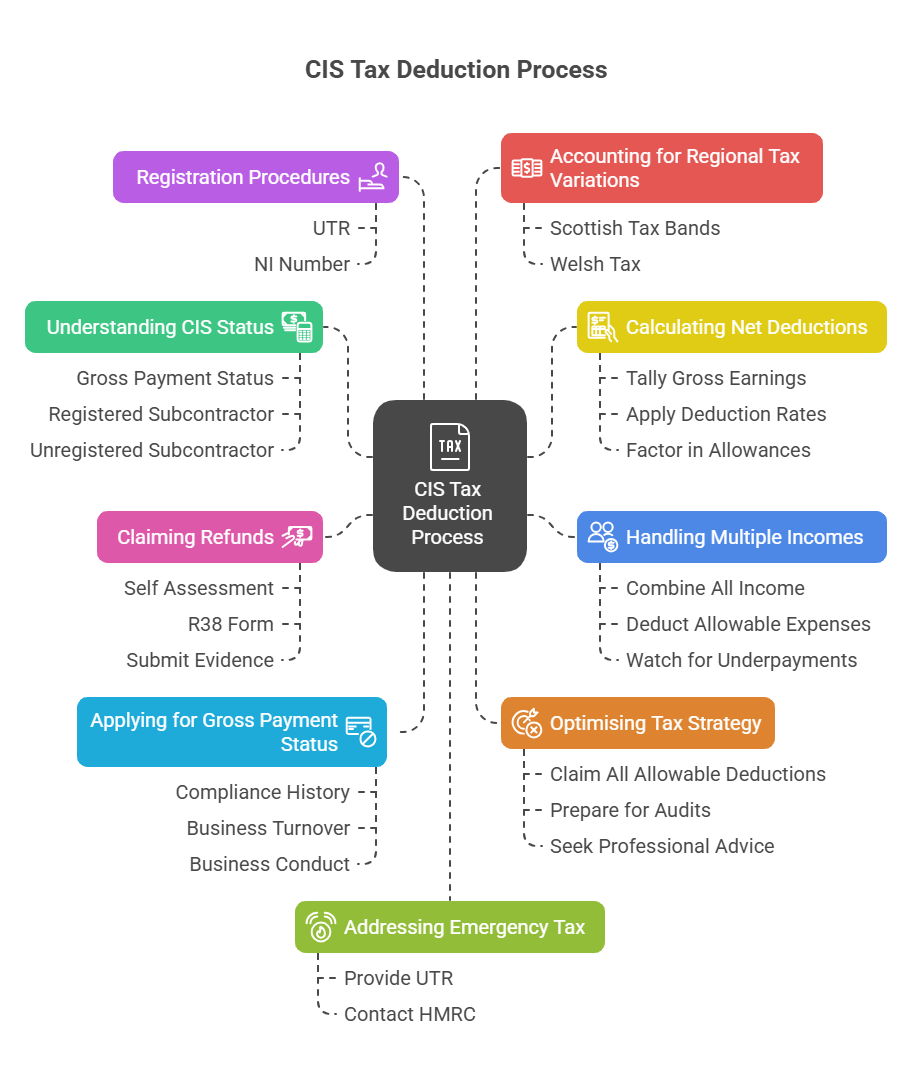
Claiming Refunds and Optimising Your CIS Position for Long-Term Success in the UK
So, the big question on your mind might be: I've spotted an overpayment – now what? Claiming refunds under CIS isn't as daunting as it seems, and in my 15-plus years as a chartered accountant, I've guided countless clients through the process to unlock funds that bolster their businesses. For the 2025/26 tax year, with no headline-grabbing shifts in deduction rates – still 20% for registered subcontractors, 30% for unregistered, and 0% for those with gross payment status – the focus is on smarter compliance and reclaiming what's yours. But recent tweaks, like the April 2025 rule classifying businesses as 'deemed contractors' if they spend over £3 million yearly on construction, mean more firms need to get savvy about refunds to maintain cash flow.
HMRC's data suggests that subcontractors often overpay by hundreds due to mismatched deductions, especially in variable trades like plumbing or electrical work. If your checks reveal excess withheld – say, because you're a basic rate taxpayer but deducted at 20% on income below the higher band – you can reclaim via Self Assessment or even earlier through your personal tax account. Let's walk through it, with tailored tips for business owners eyeing growth.
Step-by-Step Guide to Claiming a CIS Refund
Picture this: You've tallied your deductions at £10,000 for the year, but your actual tax and NI liability comes in at £7,500. That £2,500 difference? Yours for the taking. Start by logging into your personal tax account – if you've followed earlier steps, you're already set up.
Review Your Tax Overview: Under 'Income Tax', select 'Check your tax for the current year'. It'll show CIS deductions credited against your bill.
File Self Assessment if Needed: Most CIS folk need this anyway. Use SA100 to declare income, deduct expenses, and see the refund calculation automatically.
Request Interim Refund: If waiting till January 31, 2026, feels too long, apply via form R38 for overpayments mid-year – handy for cash-strapped sole traders.
Submit Evidence: Attach PDS statements and expense receipts. HMRC processes most within 4-6 weeks, direct to your bank.
Appeal if Denied: Rare, but if HMRC queries, respond within 30 days with proof.
In one case from my practice last year, a roofer in Bristol reclaimed £3,200 after realising his gross status hadn't kicked in promptly – we backdated it via appeal. For 2025/26, with personal allowances frozen, these refunds can offset inflation's bite on your real earnings.

Applying for Gross Payment Status: A Game-Changer for Cash Flow
If you're tired of deductions denting your invoices, gross payment status lets you receive full payments and settle tax at year-end. Eligibility? Turnover test (£30,000+ for sole traders, higher for companies), compliance (on-time filings for 12 months), and business test (construction-focused). But beware: From April 2024 changes carried into 2025, VAT compliance now factors in – late returns can block approval.
Apply via your HMRC account: Tick the gross payment box during registration or renewal. Reviews happen every 12 months, so maintain spotless records. I've advised clients who switched to gross and boosted working capital by 20%, reinvesting in tools or hires. If denied, appeal with evidence – one London firm I helped overturned a rejection by proving a one-off late payment was due to illness.
For business owners, this status shines if you've got multiple subs: No deductions mean smoother admin, but you must still verify everyone.
Handling Audits and Penalties: Stay Ahead of HMRC Scrutiny
None of us loves an audit, but CIS non-compliance draws them like moths to a flame – penalties up to £3,000 per month for contractors missing returns. In my experience, audits spike for firms with unreported changes, like incorporating without updating status.
Prep with this original checklist I've honed for clients:
Monthly returns filed by 19th? Tick.
Sub verifications logged? (Use HMRC tool.)
Deductions match rates? Cross-check statements.
Expenses claimed legitimately? Keep receipts for 6 years.
VAT tied in? New 2025 rules mandate checks for gross applicants.
If audited, cooperate swiftly – provide docs within 30 days. One client, a small builder in Edinburgh, faced a £1,500 fine for late filings but we reduced it to £300 via reasonable excuse appeal.
Business Deductions and Optimisation for CIS Owners
Now, let's think about your situation – if you're a business owner under CIS, deductions are just the start; optimising expenses can slash your final bill. For 2025/26, claim mileage (45p first 10,000 miles), tools, training, even home office if remote planning counts. But gig economy twists: If you're a platform worker in construction, IR35 may override CIS – deem you employed, shifting to PAYE.
Here's a custom worksheet for deducting expenses – plug in your figures:
Step 1: Categorise Costs
Travel/Fuel: £______
Materials/Tools: £______
Office/Admin: £______
Insurance/Fees: £______
Total Deductible: £______
Step 2: Adjust for Personal Use
Percentage Business: __% (e.g., van 80% work)
Allowable: £______ (total x %)
Step 3: Impact on Tax
Gross Income: £______
Minus Expenses: £______
Taxable: £______
Tax at 20%: £______ (after allowance)
Savings: £______ (vs. no claims)
This often uncovers £1,000+ in overlooked reliefs. For limited companies, corporation tax at 19-25% applies post-deductions, with CIS credits offset.
Regional Nuances and Rare Scenarios for Advanced Planning
Be careful here, because I've seen clients trip up with regional quirks. In Scotland, your refund adjusts to bands like 21% intermediate – so a £40,000 earner might owe extra despite CIS over-deductions. Welsh? Stick to English rates.
Rare cases: If emergency tax hits (30% temp), reclaim via P60 end-of-year. High earners beware child benefit charge at £60,000+ – include gross CIS in calcs. Over-65s? Grab marriage allowance for £252 tax credit.
For multiples: A CIS sub with rental income? Declare all in SA; offsets possible.
Original Case Study: Scaling a CIS Business Post-Check
Take Lisa from Cardiff, an owner scaling her decorating firm. Earning £80,000 gross CIS in 2024/25 (trends into 2025), deducted 0% via gross status, but unreported side rentals pushed her into 40% band. We optimised deductions (£15,000 expenses), claimed refund on overpaid NI, and structured for 2025 growth – saving £4,500. Key? Regular status checks and forward planning.
Summary of Key Points
Your CIS status determines deduction rates: 0% for gross, 20% registered, 30% unregistered – check via HMRC online to avoid overpayments.
Register as a subcontractor or contractor through your personal or business tax account, using UTR and NI details for quick setup.
Verify details regularly, especially after business changes like incorporating, to prevent mismatches and penalties.
Calculate net deductions manually by tallying gross earnings, applying rates, and factoring allowances – use worksheets for accuracy.
Handle multiple incomes by combining in Self Assessment, deducting expenses, and watching for underpayments from side hustles.
Account for Scottish tax band variations (e.g., 21% intermediate) and Welsh similarities when settling final bills.
Address rare issues like emergency tax by providing UTR promptly, and factor high-income charges for child benefits.
Claim refunds via Self Assessment or R38 form, submitting evidence for swift processing – often £500-£2,000 back.
Apply for gross payment status if eligible, ensuring VAT compliance under 2025 rules, to improve cash flow.
Optimise with deductions, audit prep checklists, and professional advice to grow your business while minimising tax pitfalls.

How CIS Tax Return Accountants Can Help You with CIS Management
Managing your obligations under the Construction Industry Scheme (CIS) can be a complex and time-consuming process, especially if you’re juggling multiple contractors, tax deductions, and compliance requirements. Many subcontractors and contractors alike choose to work with CIS tax return accountants to ensure they meet all their legal obligations, optimise their tax positions, and avoid costly mistakes. In this section, we’ll explore how CIS tax return accountants can help you manage your CIS responsibilities effectively, the services they offer, and why hiring a specialist accountant could be a worthwhile investment for your business.
The Role of a CIS Tax Return Accountant
A CIS tax return accountant is a specialist in the financial management and tax compliance of individuals and businesses working in the UK construction industry. These accountants are familiar with the specific requirements of the CIS, including how to manage tax deductions, gross payment status, tax refunds, and HMRC reporting. By working with a CIS accountant, you can ensure that your financial records are accurate, your tax liabilities are minimised, and you remain compliant with HMRC’s rules.
Here’s how a CIS tax return accountant can assist you with various aspects of CIS management:
Handling CIS Deductions and Tax Returns: For subcontractors, one of the biggest challenges is managing the tax deductions made by contractors. CIS accountants help ensure that these deductions are correctly reported in your self-assessment tax return, preventing overpayments and helping you claim back any over-deducted tax.
A CIS accountant can:
Ensure that all payments and deductions made by contractors are recorded accurately.
File your self-assessment tax return on time, including claims for any business expenses and tax overpayments.
Help subcontractors receive any tax refunds they are entitled to by efficiently managing the return process.
Provide ongoing support with managing your tax payments, ensuring that your tax return accurately reflects your business activities.
For example, if a subcontractor is paid by multiple contractors, the CIS accountant will gather all deduction statements, compare them with payments received, and ensure that the right amounts have been withheld for tax purposes. If any overpayments or underpayments are detected, the accountant will take the necessary steps to rectify the situation with HMRC.
Optimising Your Tax Position: A major benefit of working with a CIS tax return accountant is the opportunity to optimise your tax position. Many subcontractors are not fully aware of the tax deductions and reliefs available to them, such as claiming allowable business expenses. A CIS accountant can ensure that all eligible expenses are claimed, helping to reduce your overall tax liability.
Examples of common business expenses that CIS accountants can help subcontractors claim include:
Travel and Subsistence Costs: If you travel between job sites or need to stay overnight, these expenses can be claimed.
Materials and Tools: Any materials or tools that you purchase for your work can be deducted as business expenses.
Office Expenses: If you work from home or have an office, you may be able to claim a portion of your household or office running costs as a business expense.
Professional Fees: Accountancy fees, legal advice, and subscriptions to professional bodies can all be claimed as deductible expenses.
By ensuring that all allowable expenses are claimed, a CIS accountant helps subcontractors lower their taxable income and reduce the amount of tax owed.
Applying for and Managing Gross Payment Status: Gross payment status is a highly desirable benefit for many subcontractors, as it allows them to receive payments without any tax deductions. However, applying for gross payment status and maintaining it can be complicated. A CIS accountant can guide subcontractors through the application process, ensuring that they meet the eligibility criteria.
Once gross payment status has been granted, the accountant will:
Monitor your tax compliance to ensure that you continue to meet HMRC’s requirements for gross payment status.
Assist with maintaining accurate financial records and submitting tax returns on time to avoid revocation of gross payment status.
Help subcontractors budget effectively by setting aside the correct amount of money for tax payments at the end of the year, ensuring that there are no nasty surprises when the tax bill arrives.
For subcontractors who are unsure whether they qualify for gross payment status, a CIS accountant can provide an assessment based on turnover, tax compliance, and financial records, advising on the best course of action.
Compliance and Avoiding Penalties: CIS compliance is not optional—HMRC requires strict adherence to CIS rules, and non-compliance can result in penalties. A CIS accountant ensures that both subcontractors and contractors are fully compliant with the scheme, reducing the risk of fines and legal action.
For subcontractors, compliance includes ensuring that all tax returns are filed on time, that accurate records are kept, and that the correct deductions are applied. For contractors, compliance means verifying subcontractors’ CIS status, making the correct deductions, and filing monthly CIS returns with HMRC.
A CIS accountant can:
Ensure that all filings with HMRC are made on time, avoiding late submission penalties.
Provide ongoing advice on CIS compliance, including any changes to tax regulations that may affect your business.
Keep track of key deadlines for filing self-assessment returns, making payments on account, and submitting CIS monthly returns for contractors.
By staying up to date with tax regulations and taking care of all the administrative tasks involved in CIS, a CIS accountant helps subcontractors and contractors alike avoid penalties and stay compliant with HMRC.
Assistance with HMRC Investigations or Disputes: In the unfortunate event of an HMRC investigation or dispute, a CIS accountant can provide invaluable support. Whether HMRC is questioning the accuracy of your tax returns or investigating discrepancies in your CIS deductions, having a professional accountant on your side can make a significant difference in the outcome.
CIS accountants can:
Represent you in dealings with HMRC, providing clear explanations of your tax position and defending your case if necessary.
Prepare documentation and evidence to support your claims, such as receipts, invoices, and records of CIS deductions.
Negotiate with HMRC on your behalf if there is a need to settle disputes or agree on a payment plan for any outstanding tax liabilities.
Having a CIS accountant handle communication with HMRC can help avoid costly mistakes or delays in resolving issues. Their expertise ensures that any investigations are dealt with efficiently and professionally, giving you peace of mind during what can be a stressful time.
Choosing the Right CIS Accountant
When selecting a CIS tax return accountant, it’s important to choose someone who has experience in the construction industry and understands the specific requirements of the CIS. Here are some tips for finding the right accountant:
Specialist Experience: Look for an accountant who specialises in working with CIS subcontractors and contractors. They should have a deep understanding of the scheme’s regulations, as well as experience in handling tax returns, gross payment status applications, and HMRC compliance.
Professional Qualifications: Ensure that your accountant is a member of a recognised professional body, such as the Association of Chartered Certified Accountants (ACCA) or the Institute of Chartered Accountants in England and Wales (ICAEW). This ensures they are qualified and adhere to strict professional standards.
Communication and Transparency: Choose an accountant who is transparent about their fees and services. They should provide clear information on how they will manage your tax affairs, what you can expect from them, and how much their services will cost.
Client Reviews and Recommendations: Check online reviews or ask for recommendations from other subcontractors or contractors in the construction industry. A good CIS accountant will have a track record of satisfied clients and positive testimonials.
Technology and Software: Consider whether the accountant uses up-to-date accounting software that can integrate with your business systems. Modern cloud-based software can streamline the process of managing your CIS records, making it easier for both you and your accountant to stay on top of your tax obligations.
Example: How a CIS Accountant Can Help
Let’s consider the example of Tom, a self-employed plumber who has recently started working under the CIS. Tom has several contractors who deduct 20% from his payments, but he’s unsure how to handle his tax returns and whether he’s overpaying tax.
Tom decides to hire a CIS accountant who specialises in the construction industry. The accountant reviews Tom’s financial records, identifies several allowable business expenses that Tom had overlooked, and files his self-assessment tax return. Thanks to the accountant’s expertise, Tom receives a tax refund of £1,500, which he hadn’t expected.
The accountant also helps Tom apply for gross payment status, ensuring that he meets the eligibility criteria. With gross payment status, Tom no longer has to worry about tax deductions, giving him greater control over his cash flow and the ability to reinvest his earnings into growing his business.
A CIS tax return accountant can be an invaluable partner in helping subcontractors and contractors manage their tax responsibilities under the CIS. From filing accurate tax returns and applying for gross payment status to ensuring compliance with HMRC and optimising your tax position, the expertise of a CIS accountant can save you time, money, and stress. By outsourcing the complex and time-consuming aspects of CIS management, you can focus on growing your business and ensuring long-term success in the construction industry.
With the assistance of a qualified CIS accountant, subcontractors can avoid common mistakes, stay compliant with tax regulations, and enjoy the financial benefits of gross payment status. Contractors, too, can benefit from expert guidance on managing subcontractor payments, verifying CIS status, and filing monthly returns with HMRC. Investing in professional accounting services can be a smart move for any business operating under the CIS.
FAQs
Q1: What if a subcontractor discovers their CIS status is unregistered after starting work?
A1: Well, it's a common mix-up I've seen with new tradespeople jumping into jobs without double-checking, but don't panic – you can register retroactively via your HMRC online account, which might reduce future deductions from 30% to 20%. In my experience advising a young electrician in Bristol who faced this, we quickly submitted the form and reclaimed the excess via his next Self Assessment, saving him around £500 on his first few invoices. Just ensure you provide your UTR to the contractor ASAP to avoid ongoing higher hits.
Q2: Can subcontractors apply for gross payment status if they've only been trading for a few months?
A2: Absolutely, though it's trickier for newcomers since HMRC looks at compliance history, but if your turnover's on track for £30,000 and you've got clean records, go for it when registering. I've guided several startups in this, like a painter from Newcastle who applied early and got approved by proving consistent invoicing – it transformed his cash flow, letting him reinvest without waiting for refunds. Remember, VAT compliance is key now in 2025, so tie that in to strengthen your case.
Q3: How does CIS status verification differ for Scottish subcontractors compared to those in England?
A3: The verification process itself is identical across the UK – log into your personal tax account to check – but the real twist comes at year-end with Scotland's unique tax bands, like the 21% intermediate rate, which can mean your 20% CIS deductions might not cover enough if you're in higher brackets. Take a hypothetical joiner in Glasgow earning £35,000; his status check showed registered, but we adjusted for Scottish rates in Self Assessment to avoid a surprise bill. It's worth noting that while deductions are uniform, always preview your liability regionally.
Q4: What steps should a subcontractor take if their online CIS status shows an error, like wrong deduction rate?
A4: Start by cross-referencing your payment statements against HMRC's portal; if it's off, call the helpline right away with your UTR handy – they've fixed glitches for my clients in under a week. In one case, a tiler in Manchester had a system lag showing 30% instead of 20%, leading to over-deductions; we flagged it early, got a correction, and secured a prompt refund. Avoid delays by keeping screenshots as proof, especially if it affects multiple contractors.
Q5: How can subcontractors with multiple contractors ensure their CIS status is consistently applied?
A5: It's all about proactive sharing – once verified in your account, email your UTR and registration proof to each contractor upfront, and recheck quarterly via the portal. I've seen clients like a plumber juggling three sites get stung when one forgot to update, resulting in mismatched deductions; by setting a calendar reminder for status reviews, he avoided that pitfall and streamlined his refunds. This keeps your cash flow steady across gigs.
Q6: Is there a way for subcontractors to check past CIS deductions without waiting for statements?
A6: Yes, your HMRC personal tax account lists year-to-date deductions under the CIS section, a lifesaver for spotting discrepancies early. For instance, a roofer I advised in Leeds used this to catch a missing £1,200 deduction from last year, which we then claimed back smoothly. It's quicker than chasing contractors and helps in planning your Self Assessment without surprises.
Q7: What if a subcontractor's CIS status changes due to incorporating as a limited company?
A8: You'll need to re-register under the new entity, as status doesn't transfer automatically – log in, update details, and inform contractors to avoid 30% hits during the switch. In my practice, a builder from Sheffield overlooked this and lost £800 temporarily; we fixed it by backdating the registration, but the key is acting before your first invoice under the company name to maintain seamless deductions.
Q8: How does having a part-time PAYE job affect a subcontractor's CIS status check?
A9: Your CIS status remains separate, but combined incomes could tweak your overall tax code, so verify both via the portal to ensure no emergency tax creeps in. Consider a mechanic with a weekend garage job alongside CIS work; his status was fine, but we spotted the PAYE overlap pushing him into higher bands, adjusting allowances to prevent overpayments. It's a subtle trap, but regular dual checks keep things balanced.
Q9: Can subcontractors over 65 leverage their CIS status for extra tax reliefs?
A10: While CIS itself doesn't offer age-specific perks, your status check can highlight eligibility for marriage allowance transfers, boosting your personal allowance by £1,260 if applicable. I've helped retired-but-active fitters claim this, like one in Birmingham who combined it with CIS refunds for an extra £300 back – just factor it in during your annual review to maximise benefits without fuss.
Q11: What happens if a high-earning subcontractor’s CIS status leads to child benefit charges?
A11: If your gross CIS income tops £60,000, it triggers the charge at 1% per £200 over, regardless of status – check your portal for total earnings to forecast this. A hypothetical surveyor earning £70,000 saw his registered status fine, but we opted out of benefits early to dodge £1,500 in repayments; it's worth calculating annually, as deductions don't offset the charge directly.
Q12: How should business owners verify a subcontractor's CIS status for the first time?
A12: Use HMRC's online tool with their UTR and details – it gives instant rate confirmation, crucial to avoid penalties. In my years with London firms, one overlooked this for a new team and faced £1,000 fines; now I recommend batch verifications monthly, saving admin headaches and ensuring compliant payments from day one.
Q13: What pitfalls do business owners face when applying VAT rules to CIS gross status in 2025?
A13: New ties mean late VAT returns can block gross approvals, so align your filings meticulously before applying. A contractor client in Liverpool tripped here, delaying status and hurting cash flow; we resolved by prioritising VAT compliance first, underscoring that it's not just about turnover anymore – double-check your records to sidestep rejections.
Q14: How can business owners handle CIS status for subcontractors in partnerships?
A14: Verify each partner's details separately via the portal, as status applies per entity – mismatches can lead to wrong deductions. I've seen partnerships in Wales get tangled when one partner updated but not the other, causing overpayments; the fix is a shared checklist for joint reviews, keeping everyone on the same page.
Q15: What if a business owner spends over £3 million on construction – does it force CIS contractor status?
A15: Yes, from 2025 you're deemed a contractor even if not in the trade, so register promptly to verify subs. A property developer I advised hit this threshold unexpectedly and scrambled; early monitoring of spends prevented penalties, highlighting the need for quarterly budget reviews to stay compliant.
Q16: How do gig economy construction workers check their CIS status amid variable jobs?
A16: Treat it like standard self-employment – register if deductions apply, and use the app for quick portal access to verify. Gig platforms often overlook this, as with a delivery driver turned handyman I helped; his status check revealed unregistered, so we fixed it to drop rates from 30%, boosting his take-home on sporadic gigs.
Q17: What special considerations apply to foreign subcontractors checking CIS status in the UK?
A17: Rules mirror UK ones – register online with your details, but factor in double taxation treaties for refunds. A Polish builder working sites here forgot, facing 30% hits; we verified remotely and claimed back via treaty, saving £2,000 – always confirm work scope first, as non-UK bases don't exempt you.
Q18: Can a business owner lose gross payment status, and how to monitor for risks?
A18: Yes, if compliance slips like late filings, HMRC reviews annually – check your portal for alerts. One firm I know in Edinburgh lapsed on returns and reverted to 20%; proactive quarterly self-audits caught it early next time, preserving their flow. It's about vigilance to avoid the downgrade shock.
Q19: How does rental income alongside CIS work affect a self-employed person's status check?
A19: CIS status focuses on construction, but total income influences tax bands – verify CIS separately, then combine in Self Assessment. A landlord-subcontractor in Cardiff mixed them wrongly, underpaying; we separated streams during checks, optimising deductions and avoiding penalties. Keep incomes distinct for accurate overviews.
Q20: What if emergency tax applies due to failed CIS verification – how to resolve quickly?
A20: Provide your UTR directly to the contractor for re-verification, then confirm in your account – it flips back fast. In a rush job scenario I handled, a scaffolder got hit with 30%; quick proof submission sorted it within days, reclaiming the excess. Prevention? Share details pre-job to bypass these hiccups.
About the Author

Mr. Maz Zaheer, FCA, AFA, MAAT, MBA, is the CEO and Chief Accountant of MTA and Total Tax Accountants—two of the UK’s leading tax advisory firms. With over 14 years of hands-on experience in UK taxation, Maz is a seasoned expert in advising individuals, SMEs, and corporations on complex tax matters. A Fellow Chartered Accountant and a prolific tax writer, he is widely respected for simplifying intricate tax concepts through his popular articles. His professional insights empower UK taxpayers to navigate their financial obligations with clarity and confidence.
Disclaimer:
The information provided in our articles is for general informational purposes only and is not intended as professional advice. While we strive to keep the information up-to-date and correct, MTA makes no representations or warranties of any kind, express or implied, about the completeness, accuracy, reliability, suitability, or availability with respect to the website or the information, products, services, or related graphics contained in the articles for any purpose. Any reliance you place on such information is therefore strictly at your own risk. The graphs may also not be 100% reliable.
We encourage all readers to consult with a qualified professional before making any decisions based on the information provided. The tax and accounting rules in the UK are subject to change and can vary depending on individual circumstances. Therefore, MTA cannot be held liable for any errors, omissions, or inaccuracies published. The firm is not responsible for any losses, injuries, or damages arising from the display or use of this information.


