


The Future Of Child Benefit In The UK

The New Reality for UK Families and Child Benefit: What’s Changing in 2026
Picture this: you’re sitting at your kitchen table in March 2026, calculator in hand, trying to figure out whether it’s even worth claiming Child Benefit anymore. You’ve just realised that your salary nudged past £60,000, and the dreaded High-Income Child Benefit Charge (HICBC) is now looming over your household budget.
For many UK taxpayers, this has become an all-too-familiar scenario. But as we move deeper into the 2026 tax year, the rules, rates, and reliefs around Child Benefit are quietly evolving—and not all families are aware of what’s at stake.
According to HMRC’s 2025 projections, over 650,000 families will fall within the HICBC threshold by 2026, up from roughly 540,000 in 2023. That’s an additional 110,000 families facing reduced or clawed-back Child Benefit—many of whom never considered themselves “high earners.”
So, what’s behind this shift? Let’s break it down with clarity and precision.
Understanding Child Benefit: 2025/26 Rates and Household Implications
As of April 2025, Child Benefit rates are:
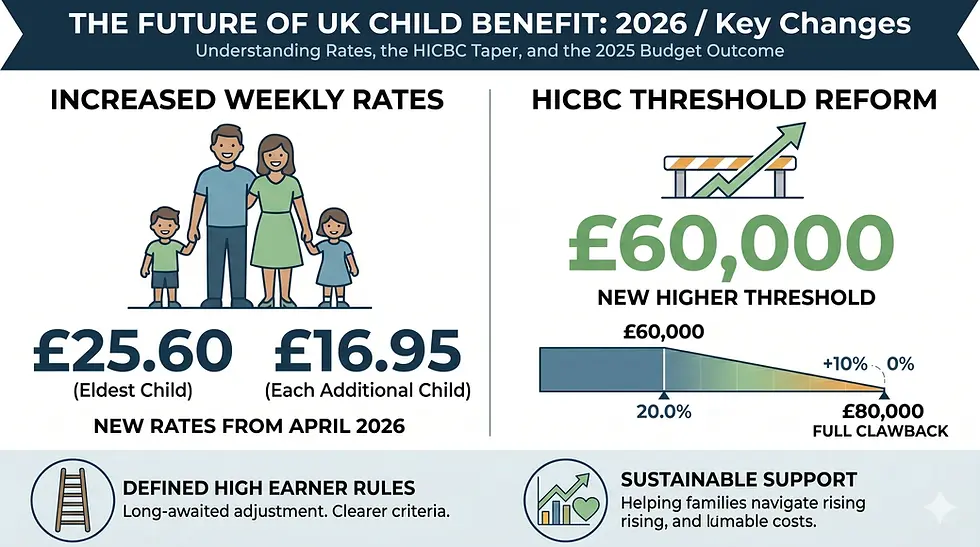
● £25.60 per week for your eldest or only child, and
● £16.95 per week for each additional child.
That’s roughly £1,331 per year for one child, or £2,046 for two—not a trivial amount, especially amid rising living costs.
But here’s where it gets complicated. Since 2013, the government has clawed back this benefit through the High-Income Child Benefit Charge (HICBC)—a tax applied to one partner’s income once it exceeds a certain threshold. Originally £50,000, this threshold has finally risen (after more than a decade) to £60,000 in April 2024, with full withdrawal by £80,000.
The 2025 Budget: What It Means for Child Benefit in 2026
In the UK Budget 2025, the Chancellor announced what many tax professionals—including myself—consider a long-overdue adjustment to the HICBC.
Here are the critical takeaways:
Income Band (2025/26) | Child Benefit Impact | Tax Rate Implication |
Up to £60,000 | Full benefit retained | No HICBC applied |
£60,001 – £80,000 | Benefit reduced by 1% for every £200 over £60,000 | Partial clawback |
Over £80,000 | Full benefit repaid via HICBC | Entire benefit lost |
This means a household with one parent earning £70,000 will repay 50% of the benefit through HICBC, effectively losing £665 per year for one child, or £1,023 for two.
What’s more, the Chancellor confirmed that from April 2026, the government intends to move to a household-based HICBC, meaning both partners’ incomes will be considered together—a move designed to address the long-standing fairness issue where single-earner households paid more tax than dual-earner ones on the same combined income.
Why Fiscal Drag Still Hurts Families
Now, even with this welcome increase in the HICBC threshold, there’s a catch. The personal allowance (£12,570) and tax bands remain frozen until at least April 2028.
This means more families are being pushed into higher tax brackets simply due to inflation and modest pay rises. For instance:
Example: If Emma earns £59,000 in 2024/25 and gets a 5% pay rise to £61,950 in 2025/26, she’s suddenly subject to the HICBC, even though her real purchasing power may have fallen.
This phenomenon—known as fiscal drag—is one of the least understood but most impactful stealth taxes in the UK today.
A Practical Example: How HICBC Is Calculated (2025/26)
Let’s run through a simple, realistic example, based on the latest rates:
Case Study: Tom from Bristol earns £70,000 in 2025/26. His partner earns £40,000. They have two children and claim Child Benefit.
Step 1: Determine excess incomeTom’s income exceeds £60,000 by £10,000.
Step 2: Calculate percentage of benefit to repay£10,000 ÷ £200 = 50 → 50% repayment.
Step 3: Calculate total Child Benefit received= £25.60 + £16.95 = £42.55/week × 52 = £2,213.
Step 4: Apply HICBC repayment50% × £2,213 = £1,106.50 to be repaid via Self Assessment.
In other words, Tom’s real Child Benefit after tax is only about £1,106, not £2,213.
Self-Employed and Company Directors: Unique Challenges
Now, let’s think about your situation—if you’re self-employed or a company director, things can get even trickier.
Because HICBC is calculated on adjusted net income (ANI), not just taxable salary, self-employed individuals and business owners can reduce their exposure through strategic planning.
Key Strategies:
● Make pension contributions (these reduce ANI directly).
● Use Gift Aid donations, which also lower ANI.
● Time dividend payments across tax years to avoid breaching £60,000 in a single year.
Personal insight: I’ve advised dozens of clients in London and Manchester who’ve managed to preserve their Child Benefit simply by making a £2,000–£3,000 pension top-up in March before filing their return. It’s one of the simplest, most effective levers available—but often missed.
Emergency Tax Codes and PAYE Pitfalls
Be careful here, because I’ve seen clients trip up when they switch jobs mid-year or hold multiple roles. HMRC may temporarily assign an emergency tax code, which can inflate your reported income under PAYE until corrected.
This can mistakenly push you into the HICBC band—even though your true annual income is below £60,000.
Always check your tax code via your Personal Tax Account.
If your code starts with “1257L W1/M1”, that’s a non-cumulative (emergency) code—meaning you’re not getting your full personal allowance spread over the year. Correcting this early can prevent unnecessary benefit clawbacks.
Checklist: How to Verify Your Child Benefit and Tax Interaction
Here’s a practical mini-checklist I often give clients to review before 5 April each year:
Step | Action | Tool/Source |
1 | Check your total taxable income (including dividends, rental income, bonuses) | HMRC Self Assessment or payslip |
2 | Review your tax code for accuracy | |
3 | Estimate your Adjusted Net Income (ANI) | GOV.UK calculator or manual method |
4 | Consider pension/Gift Aid top-ups to reduce ANI | Pension provider or charity receipts |
5 | If earning over £60k, calculate HICBC repayment | HMRC HICBC calculator |
6 | Submit Self Assessment if required | |
7 | Revisit Child Benefit claim before 5 April |
Keeping this checklist pinned above your desk (or fridge!) can save hours of frustration come January.

Hidden Winners and Losers in the 2026 Landscape
Now, not everyone will lose out under the new system. The 2024–2026 adjustments have created three broad groups:
Low to middle earners (under £60,000) – These families gain slightly in real terms, as they now keep full Child Benefit for longer.
Upper-middle earners (£60,000–£80,000) – They face partial clawbacks, but some can mitigate this through pension planning.
High earners (£80,000+) – Continue to lose all benefit, but may see changes once the new household-based system comes into play in 2026.
The big picture? Even though thresholds have shifted, fiscal drag and static allowances mean that, by 2028, as many as 900,000 families could fall under HICBC unless policies shift again.
The Critical First Step: Verify Your Income Before HMRC Does
None of us loves tax surprises — but every January, I see a wave of frantic calls from clients who’ve just opened their HMRC Self Assessment reminder and realised they owe hundreds, sometimes thousands, due to the High-Income Child Benefit Charge (HICBC).
What’s frustrating is that many of these cases could have been avoided simply by checking adjusted net income (ANI) earlier in the year.
Think of your ANI as your “true income footprint” in HMRC’s eyes — not just your salary, but everything that affects your taxable income position. And this figure alone determines how much of your Child Benefit you’ll need to repay.
How to Calculate Your Adjusted Net Income (ANI) – Step-by-Step
Let’s walk through the correct calculation, since this is where most taxpayers get caught out.
Step 1 – Start with your total taxable income:Include salary, bonuses, dividends, rental income, and savings interest.
Step 2 – Subtract allowable deductions:These include:
● Gross pension contributions (occupational or private)
● Trading losses (if self-employed)
● Gift Aid donations
● Qualifying maintenance payments
Step 3 – Arrive at your Adjusted Net Income.
Example:Laura earns £66,000 in employment income and £1,000 interest. She contributes £3,000 to a personal pension.
Her ANI = £66,000 + £1,000 – £3,000 = £64,000.
Since she’s £4,000 over £60,000, she’ll repay 20% of her family’s Child Benefit through the HICBC.
A small £2,000 pension top-up would reduce that repayment to just 10%.That’s why I tell clients: “The best Child Benefit protection strategy is often your pension.”
Using the HMRC Personal Tax Account to Check for Overpayments
Now, let’s make this actionable. You can easily verify whether your income has triggered the charge by logging into your HMRC Personal Tax Account.
Step-by-Step:
Sign in using your Government Gateway ID.
Go to “Your Income” → “Employment” → “Taxable Pay to Date.”
Check for unexpected bonuses, second jobs, or benefit-in-kind adjustments.
Cross-reference your P60 or latest payslip to confirm totals.
If you notice an anomaly (for instance, a second job coded incorrectly under the same tax code), contact HMRC immediately to prevent being misclassified for HICBC.
Real case insight:One of my clients, a nurse in Leeds, discovered her second NHS Trust role had been assigned the same tax code as her main job. It inflated her taxable pay by £12,000 for the year, triggering an unnecessary HICBC. HMRC corrected it within two weeks — but only because she checked early.
The Hidden Risk of Multiple Income Sources
If you juggle PAYE employment with side earnings — freelance work, rental property, or dividends — you need to watch your aggregate income. HMRC doesn’t automatically merge all streams when assessing HICBC; the onus is on you to report it via Self Assessment.
Income Source | Tax Reporting Requirement | HICBC Impact |
PAYE employment | Auto-reported by employer | Included in ANI |
Freelance/self-employment | Reported via Self Assessment | Included in ANI |
Dividends from company | Declared via Self Assessment | Included in ANI |
Rental income | Declared via Self Assessment | Included in ANI |
Pensions / interest | Automatically linked or declared | Included in ANI |
Be careful:I’ve seen small dividend payments or £1,000 of rental profit tip families into the HICBC zone. Always aggregate before year-end — not after your Self Assessment is due.
Self-Assessment and Child Benefit: Getting It Right
If you (or your partner) earn over £60,000 and claim Child Benefit, you must file a Self Assessment — even if all your income is taxed under PAYE.
The key is understanding where HICBC is declared. It’s part of the “Tailor Your Return” section online. Tick “Yes” when asked if anyone in your household receives Child Benefit.
HMRC will automatically calculate the amount due once you input your ANI. But don’t wait until submission — pre-calculate using the HICBC calculator on GOV.UK.
Tip from experience:HMRC’s system doesn’t account for late-year salary sacrifice or pension contributions until after your return is processed. So if you’re cutting it fine (say, £59,800 before a bonus), double-check your employer’s payroll has applied pension deductions before the tax year ends.
Business Owners and Directors: Advanced Planning Strategies
Now, if you run your own limited company, there’s greater flexibility — but also more room for error.
Company directors often draw income as a mix of salary + dividends, which makes HICBC planning more nuanced.
Three strategies that work in practice:
Balance dividends over multiple tax years.
If your total earnings hover near £60,000, consider deferring dividends until after 6 April. That simple timing shift can preserve Child Benefit for the current year.
Increase employer pension contributions.
Unlike personal contributions (which reduce ANI after grossing up), employer contributions are made directly from the company before tax — effectively reducing both corporation tax and personal ANI exposure.
Utilise Family Payroll Planning.
Pay a spouse or adult child for legitimate work in the business (admin, marketing, etc.). Not only does this spread income, but it may also keep the higher earner below the threshold — fully compliant when documented correctly.
Anecdotal insight:I’ve worked with several family-run cafés and small agencies where shifting £5,000 of director income to a working spouse made the difference between losing or keeping Child Benefit — a perfectly lawful optimisation that too few accountants flag.
Scottish and Welsh Tax Variations – What to Watch
Now, let’s not forget that tax band thresholds differ across the UK.
Region | Basic Rate | Intermediate/Starter Rate | Higher Rate | Additional Rate | Personal Allowance |
England & NI | 20% | N/A | 40% (over £50,270) | 45% (over £125,140) | £12,570 |
Scotland | 19%, 20%, 21% | 42% (over £43,662) | 45% (over £125,140) | £12,570 | |
Wales | 20% (aligned with UK) | N/A | 40% | 45% | £12,570 |
If you live in Scotland, note that higher rates kick in earlier, meaning you can be subject to HICBC even if your take-home pay feels “modest.”
Example:Fiona from Dundee earns £45,000 — just within Scotland’s higher rate band. If her employer awards a 5% raise, she crosses £47,250. Add £2,000 of rental profit, and her ANI exceeds £49,000. With another raise, she may hit the £60,000 UK-wide HICBC trigger much sooner than colleagues elsewhere.
For Scottish taxpayers, HICBC applies based on UK-wide income thresholds, not devolved bands — so the interaction can feel inconsistent. Always calculate your combined position using UK rules for benefits, not local rates.
Dealing with Overpayments or Missed Claims
Now, suppose you’ve just realised you didn’t file for HICBC in prior years — or worse, HMRC has written demanding repayment for past overclaims.
Here’s what to do:
Don’t panic. HMRC allows retrospective Self Assessments for up to four tax years.
Submit corrected returns using the online Self Assessment amendment feature.
Calculate interest: HMRC will add interest from the date Child Benefit was received, but not penalties if you notify voluntarily.
Reclaim missed years: If you opted out of receiving Child Benefit (to avoid HICBC) but would now be eligible under the £60,000 threshold, you can backdate up to three months of payments when you restart your claim.
Caution:Failing to file when required can trigger late penalties of £100 minimum — and ongoing daily fines if ignored.
Real-World Scenario: PAYE Employee with Side Income
Let’s take a practical 2026 case study.
Case Study: “James from Nottingham”
● Employment salary: £58,000
● Freelance design income: £5,000
● Pension contributions: £1,000
● One child receiving Child Benefit (£25.60/week)
Step 1:Adjusted Net Income = £58,000 + £5,000 – £1,000 = £62,000
Step 2:£62,000 – £60,000 = £2,000 excess£2,000 ÷ £200 = 10% benefit repayment
Step 3:Annual Child Benefit = £25.60 × 52 = £1,331.10% repayment = £133.10 HICBC charge.
Outcome:James keeps £1,197.90 Child Benefit after tax, but since his total income rises slowly, he should consider an additional £2,000 pension payment to eliminate the charge completely next year.
That’s the power of planning — you don’t just avoid losing benefit; you improve retirement savings too.
Checklist: Annual Child Benefit Review for 2026
Here’s an original annual review checklist I use for clients every March:
Action | Target Date | Who Should Do It |
Review total household income | 1 February | Both partners |
Estimate Adjusted Net Income | 15 February | Accountant or self-review |
Check PAYE codes | 1 March | Employee/director |
Make pension or Gift Aid adjustments | 20 March | Self-employed/employee |
Recalculate HICBC exposure | 31 March | Using HMRC calculator |
Update Child Benefit claim or opt-out | 5 April | Lead claimant |
This schedule gives families the breathing space to act before the fiscal year closes — and before HMRC does the maths for them.
Where We Stand: The System at a Crossroads
Picture this: you’re reviewing your family’s finances over breakfast, and that familiar question pops up again — “Are we still eligible for Child Benefit this year?”
For millions of UK parents, it’s a confusing reality — one that has become even more blurred as wages rise while thresholds remain frozen.
The High-Income Child Benefit Charge (HICBC) has been called one of the most controversial features of the UK tax landscape. Since its introduction in January 2013, it has caused both administrative headaches and perceived unfairness — particularly because it’s based on individual income, not household income.
According to the Budget 2025 document, the government acknowledged this imbalance and committed to exploring “a fairer household-based approach by 2026/27,” though no formal rollout date has been confirmed as of December 2025.
So, let’s unpack what this means for you — and what changes could be on the horizon.
The 2026 Shift: Towards a Household-Based Model
The current model penalises households where one partner earns over £60,000 while the other earns nothing, yet allows two partners earning £59,000 each to keep full benefit.
Under the proposed household income model, total family earnings would determine eligibility, aligning the system more closely with Universal Credit.
What Might Change (Based on 2026 Budget Signals):
● Threshold based on combined household income, possibly starting at £80,000–£90,000.
● Gradual taper, reducing benefits by 1% per £500 or £1,000 above the threshold.
● Integration with the digital HMRC household account, set to expand under Making Tax Digital (MTD) from 2026/27.
This would mark the biggest reform since 2013 — potentially benefiting middle-income families who currently lose out due to one high earner.
Professional reflection:From my own experience advising London-based families, the existing model often punishes single-income households — particularly where one parent steps back from work to raise children. A household-based threshold would restore balance and simplicity.
Inflation and Frozen Thresholds: The Quiet Tax Grab
While HICBC thresholds have been frozen since 2013 (£50,000 and £60,000), inflation and wage growth have steadily pulled more families into the charge.
Let’s quantify that:
● In 2013, £50,000 was roughly equivalent to £66,000 in today’s money (based on ONS inflation data).
● If thresholds had been indexed, the HICBC would now start around £66,000–£79,000, not £50,000–£60,000.
That means families with incomes that have merely kept pace with inflation are now losing some or all of their Child Benefit — a stealth tax by another name.
Example:A dual-income couple earning £61,000 and £28,000 now lose 10% of their Child Benefit, even though their real income hasn’t meaningfully increased since 2013.
For many, this has felt like a creeping erosion of middle-income support — especially when other allowances like the Personal Allowance (£12,570) and NI thresholds have also been frozen until April 2028.
Practical Planning for 2026 and Beyond
1. Revisit Pension Contributions
With frozen thresholds, pension contributions remain your best defence. Even small monthly increases can reduce ANI and protect Child Benefit.If you’re self-employed, remember: payments made before 5 April 2026 still count for the 2025/26 tax year.
Tip:A £200 monthly pension contribution reduces annual ANI by £2,400 — enough to reclaim 10–20% of lost Child Benefit.
2. Plan Bonus Timing Carefully
If your employer offers flexibility, consider requesting bonuses after 6 April — this moves the income into the next tax year, allowing breathing space for planning.
I’ve seen countless clients avoid unnecessary HICBC charges just by shifting bonus payments a few days forward.
3. Use Salary Sacrifice Schemes
Childcare vouchers are largely phased out, but salary sacrifice for pensions, EV schemes, or cycle-to-work programmes remain potent. They directly lower gross taxable pay — and therefore ANI.
Always confirm with your payroll provider that these are processed pre-tax, not post-tax.
4. Keep a Family Income Record
One of the most underused habits I recommend is maintaining a simple household income log — even a spreadsheet.List:
● Each partner’s gross income (including benefits-in-kind)
● Pension contributions
● Gift Aid donations
● Dividends or rental profits
At year-end, you’ll have everything ready to assess HICBC exposure — or provide your accountant with a clean summary.
5. Check for Overpayments and Refunds
Many families discover overpayments years later — often when one partner’s income dips below £50,000 after maternity leave or reduced hours.
Log in to your HMRC Personal Tax Account and use the “Child Benefit” section to view your payment and charge history.
If you’ve been overcharged, you can:
● Amend past Self Assessments for up to four years; or
● Contact HMRC directly for adjustment if your circumstances changed mid-year.
Refunds usually arrive within 8–12 weeks once approved.
Rare but Important Scenarios
Emergency Tax Codes and Mid-Year Changes
If you changed jobs mid-year and were placed on an emergency tax code, your P60 might show inflated earnings until HMRC reconciles the record. This can falsely trigger HICBC.
Always check your P45 and P60 totals match actual pay received. If not, contact HMRC before filing.
Self-Employed with Variable Income
Freelancers and contractors — especially under IR35 — should estimate income quarterly. The £60,000 line can easily be breached with an unexpectedly large contract payment.Using accounting software (MTD-compatible) will help forecast adjusted income in real time, reducing risk.
Separated or Blended Families
Only the person who receives Child Benefit (the “claimant”) faces the charge — but if they live with a new partner earning over £60,000, the charge can still apply, even if that partner isn’t the child’s parent.
Example:Zoe claims Child Benefit for her son. She earns £30,000, but her new partner earns £75,000.Despite not being the child’s father, he’s liable for HICBC.
Many families miss this nuance — but HMRC’s system doesn’t.
Looking Ahead: HMRC Modernisation and Digital Transparency
From April 2026, HMRC is set to roll out the expanded Making Tax Digital for Income Tax (MTD-ITSA) system to self-employed individuals and landlords with income above £30,000.
That means:
● Quarterly digital reporting of income and expenses;
● More accurate real-time tax calculations;
● Instant reflection of changes affecting ANI and HICBC exposure.
The end goal is clear: real-time tax fairness. Families will know their benefit position throughout the year, not just months later via Self Assessment.
Business Owners: Leveraging Future-Proof Tax Planning
If you’re a limited company director, consider a three-year Child Benefit preservation plan:
Target annual ANI under £60,000 through balanced salary/dividend structures.
Pre-fund pensions before April 2026, when allowances may tighten further.
Use spouse payroll arrangements to distribute income legitimately.
Document board decisions on timing of dividends for audit protection.
This isn’t about “gaming the system” — it’s about aligning with HMRC’s own thresholds while maximising household efficiency.
Case note:A Bristol-based design agency I advised saved £3,600 in Child Benefit repayments over three years by adopting a household income planning approach — entirely within the law.
Final Reflection: Balancing Fairness and Simplicity
As a tax adviser of nearly two decades, I’ve seen Child Benefit evolve from a straightforward family support payment into a symbol of the UK’s increasingly complex tax web.
The next few years will test HMRC’s ability to modernise without overburdening families. A shift to a household-based model, coupled with real-time digital income tracking, could finally restore transparency and fairness.
But for now — and likely through 2026 — the best approach is proactive management.Know your income. Check your tax codes. Plan before April.
Because once HMRC issues that charge, you can’t claim ignorance — only adjustment.
Summary of Key Points
Child Benefit thresholds remain £50,000–£60,000 for 2025/26, despite inflation — pulling more families into repayment.
Adjusted Net Income (ANI) determines exposure; include all sources like bonuses, dividends, and rental income.
Pension contributions and Gift Aid donations can lower ANI and preserve benefits.
Household-based reforms are expected from 2026/27, potentially shifting to combined income thresholds.
Frozen allowances until 2028 mean “fiscal drag” will continue unless thresholds are reviewed.
Scottish and Welsh taxpayers face different income bands but the same HICBC thresholds — creating uneven outcomes.
Check your HMRC Personal Tax Account annually to verify PAYE data, benefits, and possible overpayments.
Business owners and directors can plan dividend timing and employer pension contributions to manage exposure.
Making Tax Digital (MTD-ITSA) expansion in 2026 will make HICBC calculations more transparent and automated.
Early action beats late reaction: review income, contributions, and claims every February–March to stay compliant and optimise benefits.
FAQs
Q1: Can someone lose Child Benefit even if they don’t personally claim it?
Well, yes — it happens more often than people think. If your partner earns above £60,000 and you claim the Child Benefit, the high earner may still face the charge. It doesn’t matter who actually receives the money; it’s the household link that triggers liability. I’ve seen many couples surprised by this when moving in together mid-year.
Q2: How does Child Benefit interact with salary sacrifice or electric car schemes?
In my experience with company directors and employees, salary sacrifice can be a smart move. Since it reduces your gross pay before tax, it directly lowers your “adjusted net income,” meaning you could slip under the £60,000 line and avoid the charge. But make sure your HR department structures it correctly — not all schemes qualify pre-tax.
Q3: What happens if someone receives a large one-off bonus?
A common trap. A one-off bonus can push your annual income above £60,000 for a single year, triggering a partial or full Child Benefit clawback. You can still claim the benefit, but you’ll have to repay through Self Assessment. A well-timed pension contribution before 5 April can soften the hit.
Q4: Can a self-employed parent adjust their income to protect Child Benefit?
Absolutely — that’s one of the perks of flexibility. Many of my self-employed clients delay invoicing until after the tax year ends or invest in equipment before 5 April to reduce taxable profit. Just ensure those expenses are legitimate business costs. It’s a balancing act between tax efficiency and cash flow.
Q5: Does Child Benefit affect Universal Credit or tax-free childcare eligibility?
No direct overlap — Child Benefit doesn’t reduce your Universal Credit or tax-free childcare entitlement. However, if you’re near the income limits for those other benefits, a rising salary could affect them separately. Think of Child Benefit as running parallel to other schemes, but income affects them all differently.
Q6: Can someone claim back Child Benefit if their income later falls below £50,000?
Yes — but not automatically. You’ll need to re-register or restart your claim if you previously opted out. HMRC allows backdating for up to three months. I’ve seen families lose nearly £1,000 because they assumed it restarts on its own. Always check your position each April.
Q7: How does the Child Benefit charge work for couples living apart?
It’s based on whoever has the highest income — even if they don’t live with the child full-time. The key test is whether you’re “partners” under HMRC rules (living together or married/civil partnership). If separated, only the claimant’s household counts. Keep documentation clear if you’ve recently split.
Q8: What if one partner works in Scotland and the other in England?
A good question — and a confusing one. Child Benefit thresholds are UK-wide (£50,000–£60,000), even though income tax bands differ between Scotland and England. So a Scottish taxpayer might hit the charge sooner due to lower higher-rate thresholds, despite earning the same nominal salary.
Q9: How does Child Benefit work for company directors taking low salary and dividends?
Dividends count toward your adjusted net income, so directors aren’t off the hook. I often recommend keeping total drawings under £60,000 combined if possible. Timing dividend declarations strategically — even delaying by a few weeks — can preserve full Child Benefit for that year.
Q10: Can HMRC automatically reclaim overpaid Child Benefit without notice?
Yes, they can. If they detect from PAYE or Self Assessment data that you’ve crossed £60,000, they’ll adjust your tax code or issue a bill. However, they must send a notice first. If you believe it’s incorrect — say, due to pension deductions — contact them quickly with evidence before repayment begins.
About the Author

Maz Zaheer, AFA, MAAT, MBA, is the CEO and Chief Accountant of MTA and Total Tax Accountants, two premier UK tax advisory firms. With over 15 years of expertise in UK taxation, Maz provides authoritative guidance to individuals, SMEs, and corporations on complex tax issues. As a Tax Accountant and an accomplished tax writer, he is renowned for breaking down intricate tax concepts into clear, accessible content. His insights equip UK taxpayers with the knowledge and confidence to manage their financial obligations effectively.
Disclaimer:
The information provided in our articles is for general informational purposes only and is not intended as professional advice. While we strive to keep the information up-to-date and correct, MTA makes no representations or warranties of any kind, express or implied, about the completeness, accuracy, reliability, suitability, or availability with respect to the website or the information, products, services, or related graphics contained in the articles for any purpose. Any reliance you place on such information is therefore strictly at your own risk. The graphs may also not be 100% reliable.
