


Renting Out Your Old Home After Moving: The CGT Clock That Starts The Day You Leave

Index:
Renting Out Your Old Home After Moving: The CGT Clock That Starts the Day You Leave
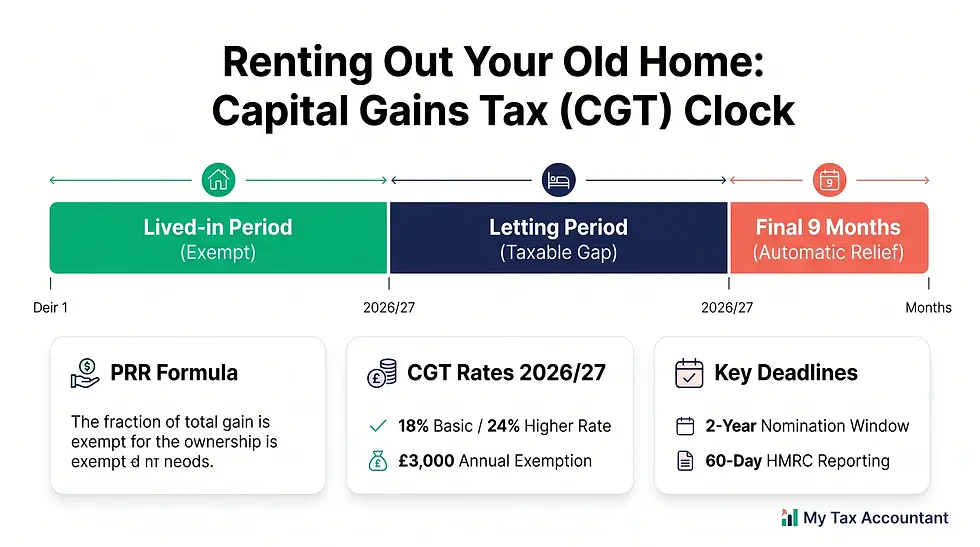
Capital Gains Tax relief on your former home does not stop the moment you move out, but the generous part of it does start winding down from that date. Private Residence Relief (PRR) automatically covers the period you actually lived in the property, plus the final nine months of ownership regardless of how the property was used in that time, but everything in between, the years it sits let to tenants after you have moved on, is chargeable unless a specific rule protects it. For 2026/27, that gap is taxed at 18% or 24% depending on your income, and understanding exactly which day starts the clock is the difference between a modest tax bill and a genuinely painful one.
I see this scenario constantly: someone buys a new home, perhaps for a job move or simply to upsize, and rather than selling the old place straightaway, lets it out. Nobody makes a conscious decision at that point about their Capital Gains Tax position, because nobody is selling anything yet. Years later, when the old property is finally sold, the CGT bill lands, and by then several of the choices that would have kept more of the gain exempt have already closed off.
How Private Residence Relief Is Actually Calculated
PRR is not an all-or-nothing relief once a property has been rented out. It works as a fraction. HMRC's helpsheet HS283 sets out the calculation clearly: you divide the period during which the property qualified for relief, meaning actual occupation as your only or main home, plus any allowed periods of absence, plus the final nine months of ownership, by your total period of ownership. That fraction of the total gain is exempt. The remainder is chargeable to Capital Gains Tax in the normal way.
This matters because the calculation runs from the day you first owned the property to the day you sell it, not simply from the day you moved out to the day of sale. A property owned for fifteen years, lived in for the first eight, then let for the remaining seven before sale, has roughly eight and a half years of relief (the eight years of occupation plus the final nine months) set against a fifteen year ownership period, leaving around six and a half years of the gain chargeable. Whether that six and a half years produces a large or small tax bill depends entirely on how much the property has actually gone up in value across the whole period of ownership, not just the years it was let.
The Final Nine Months: Automatic, No Questions Asked
The final nine months of ownership always qualify for relief, regardless of what you were doing with the property during that time, as long as it was genuinely your only or main residence at some point during your ownership. This rule exists precisely to cover the practical gap between moving out and completing a sale, and it applies automatically without any election or claim needed. It used to be far more generous. The final period exemption was 36 months until April 2014, cut to 18 months from then, and reduced again to the current nine months from April 2020, so if you are working from an older article or an out of date memory of the rules, this is worth checking specifically, since the figure has moved twice in the last decade and older content still circulates quoting 18 or even 36 months.
There is one important exception. Where the owner, or their spouse or civil partner, is disabled, or has moved into a care home, the final period exemption extends to 36 months rather than nine. This is a narrow exception and does not apply simply because a sale has taken longer than expected or the property has been difficult to let.
An Interactive Explainer for CGT that Triggers When You Leave
When you move out of your former home and let it to tenants, the Capital Gains Tax (CGT) clock starts ticking immediately, gradually winding down your available tax relief. This interactive visualiser from My Tax Accountant illustrates how HM Revenue & Customs' (HMRC) Private Residence Relief (PRR) fraction actually works, showing you precisely how much of your eventual profit remains sheltered versus what becomes taxable at 18% or 24%. Simply enter your purchase and sale details, adjust the timeline to reflect how long you lived in the property versus how long it was let, and toggle any qualifying employment absences or care-home extensions. The tool instantly calculates your exempt and chargeable gains, factors in your £3,000 annual allowance, and demonstrates the exact tax cost of holding onto your rental year after year.
Periods of Absence That Still Count as Occupation
Beyond the final nine months, there are three specific circumstances where HMRC treats a period you were not actually living in the property as if you were, provided the property was your only or main residence both before and after the absence, a condition generally known as the bracketing rule.
● Working outside the UK. If you or your spouse or civil partner were employed with all duties performed abroad, the period of absence is unlimited. There is no time cap on this category at all.
● Working elsewhere in the UK. Where your employer required you to live elsewhere in the UK to do your job effectively, up to four years of absence counts as deemed occupation.
● Any other reason. A period of absence of up to three years, for any reason at all, also counts, with no requirement to justify why you were away.
These periods can be combined and used in any order, and where they run consecutively they add together rather than each resetting to zero. A homeowner who spends three years abroad for work, returns for a period, and later takes a four year UK work posting elsewhere, can potentially claim both periods as deemed occupation in full, alongside their actual years of residence, provided they returned to live in the property as their main home after the overseas period and the general bracketing condition is met. The requirement to actually move back in is relaxed specifically where continued employment requirements genuinely prevent it, but this is a narrower exception than people often assume, and relying on it without meeting the specific conditions is one of the more common mistakes I see when a claim is later checked.
This is the rule that most changes the answer for someone who moved for a job rather than simply moving house. If your old home has been let out because your employer required you to relocate, rather than because you simply chose to move on, a meaningful part or even all of that letting period may still be covered by PRR under the working-elsewhere rules, not just the final nine months. The distinction between "I moved for work" and "I moved because I wanted to" is not just descriptive here. It is the difference between four years of protected relief and none.
UK CGT Rules for Renting Out Former Home Table
Tax Provision or Relief Standard | Qualifying Criteria and Conditions | Impact on CGT Relief / Exemption |
Private Residence Relief (PRR) & Time Apportionment | Property must be occupied as the owner's sole or main residence with a degree of permanence, continuity, and quality of residence under s222/s223 TCGA 1992. Full relief awarded if met continuously; partial relief applies via time-apportionment calculated as (Actual Occupation + Deemed Occupation) divided by Total Ownership Period. Non-UK residents must spend at least 90 midnights in the property during the tax year. | Exempts all or a proportionate part of the capital gain realized on the disposal from CGT. Any unmapped rental period accrues chargeable gains on a straight-line basis. Non-residents can make an irrevocable retrospective nomination on the NRCGT return if the 90-day condition is met. |
Final Period of Ownership Exemption (9 vs 36 Months) | Applies automatically to the final months of ownership if the property was occupied as an only or main residence at any point. Standard duration is 9 months for disposals post-April 2020 (reduced from 18 months post-April 2014 and 36 months pre-April 2014). Extended to 36 months for disabled persons or long-term care home residents (resident at least 3 months or expected to be) who hold no other relevant private residence rights (s225E TCGA 1992). | Deems the final 9 months (or 36 months for qualifying disabled/care home residents) of ownership as fully exempt from CGT, regardless of whether the property was let out, vacant, or facing difficulty finding a buyer during that final period. |
Statutory Deeming Rules for Periods of Absence (s223 TCGA92) | Requires actual physical main residence occupation both before and after the period of absence (unless prevented from returning by employer conditions or work location under s223(3B)). Covers: (1) up to 3 years for any reason; (2) unlimited time for overseas employment where all duties are performed outside the UK; (3) up to 4 years for UK work location/employer constraints or job-related accommodation with intention to occupy. | Classed as deemed occupation, preventing the CGT clock from ticking and preserving full or partial PRR coverage over those absent/rental periods. |
Restrictions on Letting Relief (s223B TCGA92) | For disposals after 5 April 2020, relief is strictly restricted to property lettings where the owner physically co-habits and shares concurrent occupancy with the tenant (e.g. renting out a bedroom). Broad letting relief for properties let in full after moving out was largely abolished. | Completely eliminates or drastically restricts relief (previously up to £40,000 per owner) if the owner moves out entirely and lets the whole property to tenants, exposing the letting period to CGT. Where applicable, relief is capped at the lowest of: PRR amount awarded, £40,000, or the gain made during letting. |
The Two-Year Nomination Window Most People Never Use
This is the point in the process that catches out more people than any other, precisely because there is nothing that prompts you to act on it. The moment you acquire a second residence, for example buying a new home while keeping your old one and letting it out, you own two properties either of which could, in principle, be your main residence for PRR purposes. Left to itself, HMRC decides which one qualifies as a matter of fact, looking at where you actually spend your time, where your family lives, where you are registered to vote, and similar indicators. For most people who have genuinely moved into a new home, that factual test points squarely at the new property, which means the old, now-let, property stops being treated as your main residence from that point onward, other than the final nine months.
You do not have to accept that outcome passively. Under section 222(5) of the Taxation of Chargeable Gains Act 1992, where you have more than one residence, you can formally elect, or nominate, which one is treated as your main residence for PRR purposes, and you have two years from the date you first had two residences to make that election. Once made, the nomination can also be varied later. This matters enormously in exactly the scenario this article is about: if you expect the old, let property to see a much larger percentage gain than your new home, perhaps because it is in an area with stronger price growth, or because you are likely to sell it sooner, actively nominating it as your main residence for part of that two year window, even briefly, can protect a meaningful slice of its eventual gain that would otherwise simply become chargeable once your factual main residence shifted to the new property.
Miss the two year window and the option is gone. This is not a relief you can claim retrospectively once you realise, years later, that the old property has appreciated significantly. It has to be actively elected within the statutory time limit, in writing to HMRC, while the position is still live.

Letting Relief No Longer Does What Many People Still Think It Does
Letting Relief used to be a genuinely valuable backstop for exactly this situation, offering up to £40,000 of additional relief on gains built up during a letting period on a property that had previously been the owner's main home. Since April 2020, it has been restricted sharply. Letting Relief for 2026/27 only applies where the owner has shared occupation of the property with the tenant during the letting period, living in the property alongside them, rather than simply having moved out and let the whole property to someone else. For the straightforward scenario this article covers, moving out entirely and letting the property as an ordinary rental, Letting Relief essentially does not apply at all, and clients who remember the old, more generous version of this relief are often disappointed to find it no longer helps them.
Rates, the Annual Exempt Amount, and Reporting Deadlines for 2026/27
Once the exempt fraction has been calculated, the chargeable portion of the gain is taxed at 18% where it falls within your remaining basic rate band for the tax year, and 24% on any amount above that, rates that have applied to residential property gains since the rate structure was aligned across asset types from 30 October 2024. Every individual has an annual exempt amount of £3,000 for 2026/27, available against the chargeable gain before tax is calculated, though this cannot be carried forward if unused.
Where Capital Gains Tax is actually due on the sale of a UK residential property, it must be reported and paid within 60 days of completion, using HMRC's dedicated UK property reporting service, separately from your annual Self Assessment return. Where the gain is fully covered by PRR or falls within your annual exempt amount, no report is needed at all. Missing the 60-day deadline where tax is due triggers automatic penalties and interest, and this is a genuinely common trap for someone selling a former home they have not lived in for years, since they are often focused on the sale itself rather than remembering a separate, fast-moving tax deadline sits alongside it.
An Interactive Explainer for Renting Out Your Old Home After Moving
This interactive widget explains the Capital Gains Tax implications of renting out your former home after you move in the UK, focusing on how Private Residence Relief works, the nine-month final period exemption, periods of absence that may still qualify, the two-year nomination window, the restricted Letting Relief rules, and the 2026/27 rates and 60-day reporting deadline. Simply click through the tabs at the top to explore each topic in clear, plain language, expand the accordion sections for extra detail, and use the built-in estimator to get a rough idea of any potential tax bill based on your own figures. Everything is presented for UK taxpayers and reflects current HMRC guidance, with the widget created by My Tax Accountant.
The Scottish and Welsh Position
Capital Gains Tax is a reserved matter, not a devolved one, so the rates, the annual exempt amount, the PRR calculation, the nomination election, and the 60-day reporting rule all apply identically whether the property is in England, Scotland, or Wales. This is worth being explicit about because it differs from the position for Income Tax, where Scotland and Wales set their own rates and bands. A Scottish taxpayer's CGT liability still uses the UK-wide basic rate limit to determine how much of a gain is taxed at 18% rather than 24%, not the Scottish income tax bands that apply to their salary or other income, which is a distinction worth flagging since it genuinely surprises Scottish clients who assume their devolved tax position carries through automatically. The only tax that differs by nation in this scenario is Land and Buildings Transaction Tax in Scotland or Land Transaction Tax in Wales, and those apply on the purchase of a property, not its sale, so they have no bearing on the CGT position covered here.
A Worked Example
Take a homeowner who bought a flat for £180,000, lived in it for six years, then relocated for a new job to a different part of the country. The relocation was not required by the employer, simply a choice to take a better role elsewhere, so the working-elsewhere deemed occupation rules do not apply. The flat was let out for the following seven years and then sold for £340,000, a gain of £160,000 before costs.
Total ownership was thirteen years. Relief covers the six years of actual occupation plus the final nine months of ownership, roughly six years and nine months out of thirteen years, or a fraction of 81/156. Applying that fraction, £83,077 of the gain is exempt. The remaining £76,923 is chargeable, reduced by the £3,000 annual exempt amount to £73,923. If this homeowner has other income pushing them into the higher rate band, tax at 24% comes to £17,742. If, instead, this same person had made a section 222(5) nomination during the two year window after buying their new home, actively electing the flat as their main residence for part of the letting period before switching the nomination to the new home, a further slice of that gain could have been protected, potentially reducing the bill by several thousand pounds depending on exactly how the nomination was timed against the flat's own price growth during those years.
Common Mistakes I See
● Assuming the "any reason" three year absence rule applies automatically to any letting period, without checking whether the reoccupation condition was actually met.
● Confusing a voluntary move with an employer-required relocation, when only the latter unlocks the more generous UK working-elsewhere or overseas rules.
● Missing the two year window to nominate a main residence entirely, simply because nobody prompts you to think about it at the point you buy a second property.
● Assuming Letting Relief still offers up to £40,000 of protection, when for a wholly let former home since April 2020 it generally does not apply at all.
● Treating the sale of a former home casually because "it used to be my house," and missing the 60-day reporting and payment deadline that applies once CGT is actually due.
Key Takeaways
● Private Residence Relief covers actual occupation as your main home plus the final nine months of ownership automatically, but time spent let out beyond that is chargeable unless a specific rule applies.
● Absence due to overseas employment is unlimited, absence due to UK employment elsewhere is capped at four years, and absence for any other reason is capped at three years, all requiring reoccupation as your main home before and after.
● You have two years from acquiring a second residence to elect which property is your main residence for PRR purposes under section 222(5) TCGA 1992, a window that closes permanently once missed.
● Letting Relief now only applies where the owner shared occupation with the tenant, so it generally offers no protection for a former home let out in full after the owner has moved elsewhere.
● CGT rates for 2026/27 are 18% and 24%, the annual exempt amount is £3,000, and UK residents must report and pay within 60 days of completion where tax is due, rules that apply identically across England, Scotland, and Wales.
FAQs
Do I pay Capital Gains Tax on my old home if I moved out and rented it before selling?
Possibly, on the portion of the gain relating to the period after you moved out, beyond the final nine months of ownership, unless that period is covered by an allowable absence rule or a main residence nomination made within the required time limit.
How is the exempt portion of the gain worked out?
By dividing the months of qualifying occupation, including the final nine months of ownership which always count, by the total months you owned the property, and applying that fraction to the total gain.
Does it make a difference if I moved for a new job rather than by choice?
Yes, significantly. If your employer required you to relocate, the period the old home was let can potentially be treated as deemed occupation, either unlimited if the work was overseas or up to four years if it was elsewhere in the UK, rather than only benefiting from the standard three-year any-reason absence rule.
What is the nomination election and why does the two year window matter?
It is a formal choice under section 222(5) of the Taxation of Chargeable Gains Act 1992 about which of two or more residences counts as your main home for relief purposes. You have two years from acquiring the second property to make it, and once that window closes you cannot elect retrospectively.
Can I still claim Letting Relief on a property I let out after moving away?
Generally no, if you moved out entirely. Since April 2020, Letting Relief only applies to periods where you shared occupation of the property with your tenant, not to a property let in full after the owner has relocated elsewhere.
What CGT rate will I pay on the gain from my former home in 2026/27?
18% on the part of the gain within your remaining basic rate band, and 24% on the part above it, the same rates that apply to all residential property gains since the rate structure was aligned in October 2024.
Do I need to tell HMRC within a set time after selling?
Yes, if any Capital Gains Tax is due, UK residents must report the sale and pay the tax within 60 days of completion using HMRC's UK property reporting service, separately from a Self Assessment return. No report is needed if the gain is fully covered by relief or your annual exempt amount.
Do the rules work differently if my property is in Scotland or Wales?
No, Capital Gains Tax is a UK-wide reserved tax, so the rates, reliefs, and reporting deadlines described here apply identically regardless of whether the property is in England, Scotland, or Wales, even though Income Tax rates themselves differ by nation.
About the Author

Maz Zaheer, AFA, MAAT, MBA, is the CEO and Chief Accountant of MTA and Total Tax Accountants, two premier UK tax advisory firms. With over 15 years of expertise in UK taxation, Maz provides authoritative guidance to individuals, SMEs, and corporations on complex tax issues. As a Tax Accountant and an accomplished tax writer, he is renowned for breaking down intricate tax concepts into clear, accessible content. His insights equip UK taxpayers with the knowledge and confidence to manage their financial obligations effectively.
Disclaimer:
This article explains the general position for the 2026/27 tax year and is accurate at the date of publication. Tax outcomes depend on individual circumstances, and rules change. It is not advice for your situation. For guidance on your own position, speak to a qualified accountant or tax adviser. My Tax Accountant accepts no liability for action taken solely on the basis of this article.
