


Savings Tax Rising To 24%: How Much More Tax You Will Pay On Your Interest From April 2027

Index:
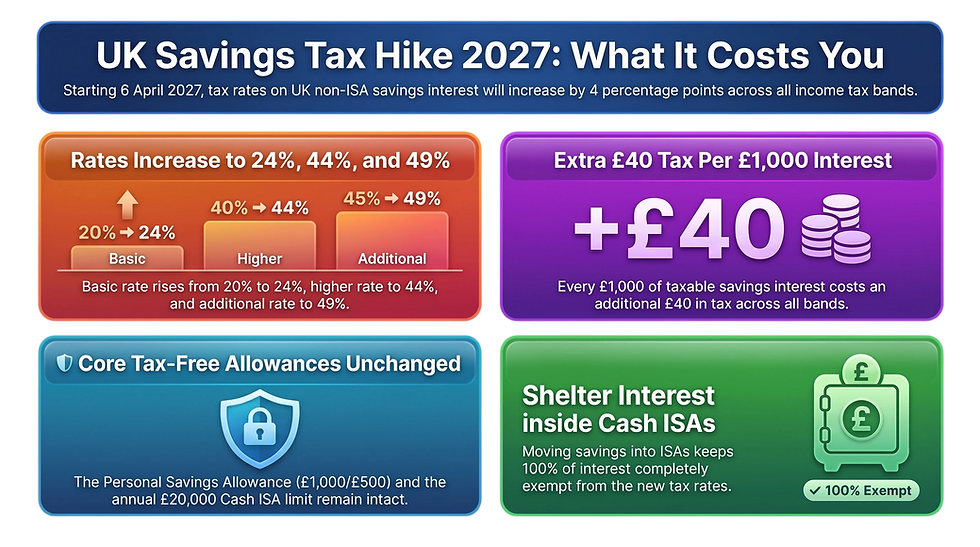
From 6 April 2027, Income Tax on savings interest rises to 24% for basic rate taxpayers, 44% for higher rate taxpayers and 49% for additional rate taxpayers, across the whole UK. Against the 2026/27 rates of 20%, 40% and 45%, every £1,000 of taxable interest will cost you £40 more, whichever band you fall into.
That figure comes from two Budgets. Budget 2025 had already set a 2 percentage point rise from April 2027, which would have taken the rates to 22%, 42% and 47%. The Budget 2026 report, laid before Parliament by HM Treasury on 28 October 2026, adds a further 2 points from the same date, and the change will be legislated in Finance Bill 2026-27.
The allowances that keep most interest tax-free are not changing. The Personal Savings Allowance, the starting rate for savings and the £20,000 cash ISA limit all survive. That is why HM Treasury's Budget 2026 report states that 84% of income tax payers will be unaffected by the savings and property rate rises in 2027/28. The question for you is whether you are in the other 16%, and by how much.
What are the savings tax rates for 2026/27 and 2027/28?
Savings income means interest from bank and building society accounts, fixed-term bonds, gilts and corporate bonds, peer-to-peer lending, most NS&I products other than Premium Bonds, and interest HMRC pays you on a tax repayment. It is taxed at its own set of rates, separate from the rates on your salary, pension or profits.
Your band | 2026/27 rate | 2027/28 rate (Budget 2026) | Personal Savings Allowance | Extra tax per £1,000 of taxable interest |
Basic rate | 20% | 24% | £1,000 | £40 |
Higher rate | 40% | 44% | £500 | £40 |
Additional rate | 45% | 49% | £0 | £40 |
The Personal Savings Allowance is a slice of interest taxed at 0% each tax year, and its size depends on your band. Separately, the starting rate for savings gives up to £5,000 of interest at 0%, but that £5,000 shrinks by £1 for every £1 of your other income (wages, pension, profits, rent) above the £12,570 Personal Allowance. The current amounts are set out in the GOV.UK guidance on tax on savings interest.
How much more will you pay on your interest from April 2027?
The arithmetic is simple once you know your taxable interest, meaning the interest left after your allowances. Multiply it by 4% and you have the increase compared with 2026/27. The table below takes four typical profiles, each assuming the thresholds stay frozen and the savings earn the same interest in both years.
Example | Other income | Interest | Tax on interest 2026/27 | Tax on interest 2027/28 | Increase |
Retired, small pension | £14,000 pension | £4,000 | £0 | £0 | £0 |
Basic rate employee | £40,000 salary | £2,400 | £280 | £336 | £56 |
Higher rate employee | £70,000 salary | £5,000 | £1,800 | £1,980 | £180 |
Additional rate earner | £150,000 salary | £10,000 | £4,500 | £4,900 | £400 |
Example: the retired saver. Their pension uses the £12,570 Personal Allowance and leaves £1,430 of taxable pension, so the starting rate band falls from £5,000 to £3,570. Add the £1,000 Personal Savings Allowance and they can receive £4,570 of interest before paying any tax. The rate rise does not touch them unless their interest goes above that figure.
Example: the basic rate employee. They hold £60,000 at 4%, giving £2,400 of interest. Their salary already uses up the starting rate, so only the £1,000 Personal Savings Allowance applies, leaving £1,400 taxable. At 20% that is £280; at 24% it is £336.
Example: the higher rate employee. They hold £125,000 at 4%. After the £500 allowance, £4,500 is taxable at 40% in 2026/27 and 44% in 2027/28. The additional rate earner has no allowance at all, so all £10,000 is taxed.
The Budget 2026 report gives its own benchmark: at an average interest rate of 4%, a basic rate taxpayer needs more than £25,000 in savings outside an ISA before any tax is due.
The video in this section works through these four examples and the bond example below. Its main conclusion is that the rate rise adds £40 per £1,000 of taxable interest, but the larger risk for many savers is interest landing in a year when it pushes them into a higher band.
Interactive UK Savings Tax Dashboard: Preparing for the April 2027 Rate Rises
This interactive dashboard illustrates exactly how the upcoming April 2027 Income Tax rises will impact the returns on your hard-earned savings. With rates climbing to 24% for basic rate taxpayers and up to 49% for additional rate earners, understanding your precise tax exposure is crucial for effective financial planning. Simply review the comparative charts and typical saver profiles to see a clear breakdown of the extra tax you will pay on your taxable interest compared to the current 2026/27 tax year. Use these insights, provided by My Tax Accountant, to help you make informed decisions about your allowances, ISAs, and fixed-term bond maturities before the new rules take effect.
Does the rise affect you if all your interest is covered by your allowance?
No tax is due on interest covered by the Personal Savings Allowance, at 20% or 24%. The allowance still counts as part of your income, though. Interest taxed at 0% uses up part of your basic rate band, and it counts towards the £50,270 and £100,000 thresholds, which is why the allowance can disappear as your interest grows.
Why the date your interest is paid matters more than ever
HMRC taxes interest in the tax year it is paid or credited to you, not the years in which it built up. That is long-standing practice. What changes on 6 April 2027 is the price of getting the timing wrong, because a payment on 5 April 2027 is taxed at 2026/27 rates and one on 6 April 2027 at the new ones.
The bigger effect comes when a lump of interest pushes your income over a threshold. Rates in the table above are only the first layer.
Example: an employee on a £45,000 salary holds a two-year fixed-term bond earning £6,000 of interest in total.
● Interest paid yearly, £3,000 in 2026/27 and £3,000 in 2027/28. Total income each year is £48,000, so they remain a basic rate taxpayer with a £1,000 allowance. Tax is £400 in 2026/27 (£2,000 at 20%) and £480 in 2027/28 (£2,000 at 24%), a total of £880.
● All £6,000 paid at maturity in 2027/28. Total income becomes £51,000, which is above £50,270, so they become a higher rate taxpayer and the allowance falls to £500. Their remaining basic rate band is £5,270: £500 at 0%, £4,770 at 24% (£1,144.80) and the last £730 at 44% (£321.20). Tax is £1,466.
The same savings cost £586 more in tax purely because of how the interest is paid. The decision boundary for this employee is £5,270 of interest in a single tax year; anything above that tips them into the higher rate band and halves their allowance.
At the top end, the effect is sharper. Between £100,000 and £125,140 of income, you lose £1 of Personal Allowance for every £2 of extra income. Where interest is the top slice of your income, each extra £1,000 of interest costs £440 at 44%, plus £220 on the £500 of allowance it wipes out. My Tax Accountant's calculation is that this gives an effective rate of 66% on interest in that band from 6 April 2027, against 60% in 2026/27.
How will HMRC collect the extra tax?
Banks and building societies have paid interest without deducting tax since 6 April 2016 and report what they pay to HMRC each year. If you are employed or draw a pension, HMRC usually collects tax on interest by reducing your tax code, using an estimate based on your interest from an earlier year. An estimate made at 20% will not reflect 24% unless HMRC updates it, so your 2027/28 tax code deserves a close look when it arrives.
If you file a Self Assessment return, the extra tax arrives late. Your payments on account for 2027/28, due on 31 January 2028 and 31 July 2028, are based on your 2026/27 bill at the old rates. The increase lands in your balancing payment on 31 January 2029, along with the first payment on account for 2028/29, which will be set at the higher level.
The Treasury's own figures reflect that delay. The Budget 2026 costings show the savings rate rise raising £15 million in 2026/27, £125 million in 2027/28 and £555 million in 2028/29. My Tax Accountant reads that profile as a sign that most of the extra tax will be paid through Self Assessment balancing payments in January 2029, not through tax codes during 2027/28.
Scottish and Welsh taxpayers
Budget 2026 confirms that the 24%, 44% and 49% savings rates apply across the UK. Savings income is not devolved, so Scottish and Welsh taxpayers pay the same savings rates as everyone else, using the UK bands rather than the Scottish or Welsh rates that apply to earnings and pensions.
For Scottish taxpayers this creates a mismatch. You can pay a Scottish higher or advanced rate on your salary while your interest is still taxed at the UK savings basic rate of 24%, because the UK higher rate threshold of £50,270 governs your savings. The Scottish bands are explained in the GOV.UK guide to Scottish Income Tax, and the UK bands that govern your interest in the GOV.UK Income Tax rates and bands.
Which allowances still shelter interest after April 2027?
Interest earned inside an Individual Savings Account (ISA) is free of Income Tax, so the rate rise does not reach it. The Budget 2026 report reversed the planned reduction and kept the annual cash ISA limit at £20,000; your 2026/27 ISA allowance must be used by 5 April 2027 or it is lost. The GOV.UK guidance on Individual Savings Accounts sets out the subscription rules.
Interest on a joint account is normally split equally between spouses or civil partners. If one of you pays tax at a lower band, or has an unused starting rate, savings held in that person's name are taxed at that person's rate, provided the money is an outright gift. Savings given by a parent to a child are taxed on the parent if the child's interest from that gift exceeds £100 in a tax year.
Choosing a particular account, bond or investment is a financial product decision and needs advice from a suitably qualified and regulated adviser. This article covers only how the interest is taxed.

When should you get help with this?
The calculation stays simple while all your interest is taxable at one rate. It stops being simple when your income sits near £50,270 or £100,000, when a bond pays out in one sum, when you also receive dividends or rental income (property income rates also rise to 24%, 44% and 49% from 6 April 2027 in England, Wales and Northern Ireland, which is a separate matter), or when joint accounts are not owned equally.
In that position a professional works out, year by year, how your Personal Allowance, starting rate, Personal Savings Allowance and bands interact before you commit money to a fixed term. Through its Self Assessment tax return service, My Tax Accountant lists your accounts and the dates each pays interest, checks HMRC's estimate in your tax code, calculates the tax on your interest at the right rate in the right year, and prepares and files your return.
What to do before 6 April 2027
By 5 April 2027: list every account you hold, including joint and online-only accounts, with its interest rate and the date interest is paid or credited.
By 5 April 2027: for each fixed-term account, note whether its interest is paid yearly or in one sum at maturity, and which tax year that falls in.
By 5 April 2027: estimate your total 2027/28 income, including all interest, and check whether it crosses £50,270, £100,000 or £125,140.
By 5 April 2027: decide whether to use your £20,000 2026/27 ISA allowance and whether savings should sit in the name of the spouse with the lower income.
When your 2027/28 tax code arrives: check the figure for untaxed interest against your own estimate and ask HMRC to correct it if it is wrong.
By 5 October 2028: register for Self Assessment if your 2027/28 interest is above £10,000 or HMRC has asked you to file.
By 31 January 2029: file your 2027/28 return and pay the balancing payment, which is where most of the higher tax will fall.
.
Key takeaways
● From 6 April 2027 savings interest is taxed at 24%, 44% and 49% across the UK, up from 20%, 40% and 45% in 2026/27.
● Every £1,000 of taxable interest costs £40 more, in every band.
● The Personal Savings Allowance (£1,000, £500 or £0), the £5,000 starting rate for savings and the £20,000 cash ISA limit are unchanged.
● The date interest is paid decides which year's rate applies, and a single large payment can cost far more than the rate rise alone.
Frequently asked questions
Does the 24% rate apply to dividends as well?
No. The Budget 2026 increase applies to savings income and property income, not dividends. Dividends have their own rates and their own £500 dividend allowance; Budget 2025 had already raised the dividend ordinary and upper rates to 10.75% and 35.75% from 6 April 2026.
Are Premium Bond prizes taxed at the new savings rates?
No. Premium Bond prizes are free of Income Tax and do not count towards your Personal Savings Allowance, so the April 2027 rise does not affect them. Interest on other NS&I products, such as Income Bonds and Direct Saver, is taxable savings income.
Will my bank take the 24% tax off my interest automatically?
No. UK banks and building societies pay interest gross and report it to HMRC. HMRC then collects any tax through your tax code, a Simple Assessment letter or your Self Assessment return.
Is interest from an overseas bank account taxed at 24% too?
Yes, if you are UK resident. Interest from a foreign account is savings income and is taxed at the UK savings rates from 6 April 2027, whether or not you bring it to the UK, unless you have claimed the four-year foreign income and gains relief available to new UK residents. Foreign tax already paid can usually be offset against the UK tax through Foreign Tax Credit Relief.
Does the rate rise affect interest I received before April 2027 but report later?
No. The rate is set by the tax year in which the interest was paid or credited, not the date you file. Interest paid on or before 5 April 2027 is taxed at 20%, 40% or 45%, even if you report it on a return filed in January 2028.
About the Author

Maz Zaheer, AFA, MAAT, MBA, is the CEO and Chief Accountant of MTA and Total Tax Accountants, two premier UK tax advisory firms. With over 15 years of expertise in UK taxation, Maz provides authoritative guidance to individuals, SMEs, and corporations on complex tax issues. As a Tax Accountant and an accomplished tax writer, he is renowned for breaking down intricate tax concepts into clear, accessible content. His insights equip UK taxpayers with the knowledge and confidence to manage their financial obligations effectively.
Disclaimer:
This article explains the general position for the 2026/27 tax year and is accurate at the date of publication. Tax outcomes depend on individual circumstances, and rules change. It is not advice for your situation. For guidance on your own position, speak to a qualified accountant or tax adviser. My Tax Accountant accepts no liability for action taken solely on the basis of this article.
