


Section 24 Mortgage Interest Relief In 2026/27: The 20% Credit Worked Through Real Numbers


Section 24 Mortgage Interest Relief in 2026/27: The 20% Credit Worked Through Real Numbers
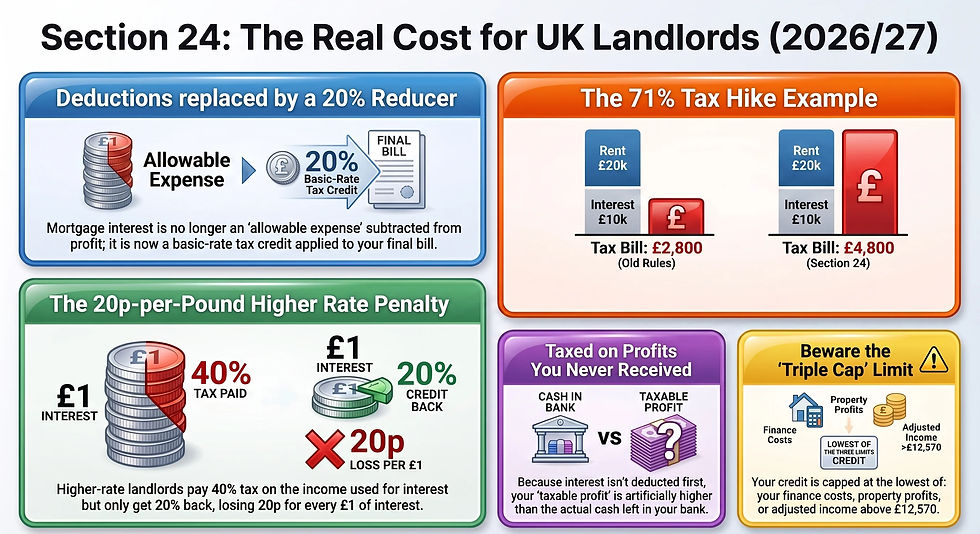
Section 24 of the Finance (No. 2) Act 2015 stops individual landlords deducting mortgage interest and other residential finance costs from rental income when working out taxable profit. Instead, for the 2026/27 tax year, HMRC applies a basic rate tax reducer worth 20% of the lowest of three figures: your finance costs, your property business profit, or your adjusted total income above the personal allowance, as set out in HMRC's own guidance on how the relief is calculated. For a basic rate taxpayer this produces broadly the same outcome as the old system. For everyone else, it does not, and the reasons why are more subtle than most explanations of Section 24 make clear.
I have sat through enough of these conversations to know that landlords generally understand the headline point, mortgage interest no longer comes off rental income directly, but far fewer understand exactly how the 20% reducer is capped, or why the change can quietly push their income across thresholds that have nothing to do with property at all. That second point is where the real damage tends to happen, and it is the part most generic explanations skip.
How the 20% Reducer Actually Works
The mechanics start by adding your full finance costs back into your taxable rental profit, so the profit figure that flows into your overall tax calculation is your rental income minus everything except the interest. That gross-of-interest profit is taxed at your normal income tax rate, whatever band it falls into. Separately, HMRC calculates a tax reducer, 20% of the lowest of your finance costs for the year, your property business profit for the year, or your adjusted total income (broadly, your income after deducting the personal allowance and other reliefs, but before this reducer is applied) for the year. That reducer is then deducted directly from your income tax bill, not from your taxable profit.
The three-way cap matters because it means the reducer cannot simply be assumed to equal 20% of your interest bill. Where your property profit is small relative to your finance costs, perhaps because you are highly leveraged, the reducer is limited to 20% of the smaller profit figure, not the larger interest figure, and any unused finance cost is carried forward to set against future years under the same restriction, indefinitely, with no expiry.
Worked Example: Basic Rate Taxpayer
Take a landlord with £16,000 of rental income, £4,000 of allowable expenses excluding interest, and £5,000 of mortgage interest for the year. Their taxable property profit, calculated without deducting interest, is £12,000. Combined with a modest part-time salary of £14,000, their total income for the year sits within the basic rate band throughout. The tax reducer is 20% of the lowest of £5,000 (finance costs), £12,000 (property profit), and their adjusted total income above the personal allowance, which comfortably exceeds £5,000, so the reducer is £1,000. Because this landlord's whole income sits within the basic rate band, the practical result is close to what they would have received under the old system of deducting interest directly, since 20% relief matches their 20% marginal rate.
Worked Example: Higher Rate Taxpayer
Now take a landlord with a £55,000 salary and a single rental property generating £18,000 of rental income, £3,000 of allowable expenses, and £8,000 of mortgage interest. Their taxable property profit, before any interest deduction, is £15,000, and this is added to their salary in full, making their total taxable income £70,000, comfortably into higher rate territory at 40%. The full £15,000 of property profit is taxed at 40%, generating a tax charge of £6,000 on the property income alone, before any reducer is applied. The reducer is then 20% of the lowest of £8,000 (finance costs), £15,000 (property profit), and their adjusted total income above the personal allowance, so £1,600. Their net tax on the property income works out at £4,400, an effective rate of roughly 29% on a profit that, after genuinely deducting the interest, would only have been £7,000. Under the pre-2017 rules, that £7,000 net profit taxed at 40% would have produced a bill of £2,800, considerably less than the
£4,400 now due.
How the Widget Works: Navigating the rules around Section 24 mortgage interest relief can often feel overwhelming for individual landlords. We designed this interactive widget to help you clearly understand how the 20% tax reducer applies to your specific financial situation. Simply enter your rental income, allowable expenses, mortgage interest, and other earnings to see the underlying calculations in real time. The tool automatically works out your property profit and checks it against your adjusted total income to determine your exact eligible relief. This immediate clarity allows you to accurately forecast your tax liabilities and make informed decisions about your property portfolio.
The Hidden Problem: Section 24 Pushes Total Income Higher, Not Just the Tax Rate
This is the part I find myself explaining to clients more than any other aspect of Section 24, because it is genuinely counterintuitive and rarely covered in generalist material. Because the full rental profit, gross of interest, counts as part of your total income for every other threshold test in the tax system, Section 24 does not just increase the rate at which property profit itself is taxed. It can drag your overall income across thresholds you would never have crossed had interest still been deducted normally.
The personal allowance taper is the clearest example. HMRC's guidance on adjusted net income confirms that the personal allowance, £12,570 for 2026/27, is reduced by £1 for every £2 of adjusted net income above £100,000, disappearing entirely once income reaches £125,140, creating an effective marginal rate of 60% across that band. A landlord whose salary and genuine, after-interest rental profit would together sit at, say, £96,000, could easily find their gross-of-interest rental profit pushes their adjusted net income above £100,000 once Section 24's add-back is applied, triggering the taper on income that, in real economic terms, they never actually received.

A Worked Example: Tipped Into the Personal Allowance Taper
Take a landlord with an employed salary of £88,000 and a rental portfolio generating £22,000 of rental income, £4,000 of allowable expenses, and £10,000 of mortgage interest. Their genuine, after-interest rental profit is £8,000, and combined with their salary that would suggest a total income of £96,000, safely below the £100,000 taper threshold. But because Section 24 requires the full pre-interest profit of £18,000 to be included in taxable income, their adjusted net income for personal allowance purposes is actually £106,000, £6,000 into the taper band. Their personal allowance is reduced by £3,000 (£1 for every £2 over £100,000), meaning an additional £3,000 of income that would otherwise have been tax-free is now taxed at 40%, an extra £1,200 in tax, entirely as a side effect of the interest add-back rather than any real increase in their income.
A Worked Example: The Child Benefit Trap
The same mechanism affects the High Income Child Benefit Charge (HICBC). HMRC's guidance on the charge confirms that for 2026/27, the charge begins tapering Child Benefit once the higher earner's adjusted net income exceeds £60,000, and Child Benefit is withdrawn in full once income reaches £80,000, clawed back at 1% for every £200 of income above the £60,000 threshold. A landlord and parent with a £58,000 salary and a rental property generating £14,000 of income, £2,000 of expenses, and £6,000 of mortgage interest has a genuine after-interest profit of £6,000, suggesting total income of £64,000, well within the tapering zone but nowhere near full withdrawal.
Once Section 24 requires the full £12,000 pre-interest profit to count, their adjusted net income becomes £70,000, considerably further into the taper, and their Child Benefit clawback is materially higher than their real economic income would justify. For a family with two children, this can mean losing several hundred pounds a year of Child Benefit they would otherwise have retained, purely because of how the finance cost restriction defines income for this purpose.

Not sure How You Can Benefit From Section 24 Mortgage Interest Relief?
No two situations are quite the same, and the rules rarely fit neatly. Tell us your circumstances and one of our UK tax specialists will give you a straight answer on where you actually stand. Free, no obligation.
Carrying Forward Unused Finance Costs
Where the three-way cap restricts the reducer below 20% of your actual finance costs, most commonly because your property profit for the year is smaller than your interest bill, the unused portion is not lost. It carries forward and can be relieved in a future tax year, again subject to the same cap applying in that later year. This matters for landlords going through a period of low rental profit, perhaps due to a void period, major repair costs, or a temporary rent reduction, since interest that cannot be relieved this year is not wasted, only deferred. Keeping a clear year-by-year record of carried-forward finance costs is worth doing properly, since HMRC does not track this for you in a way that is easy to reconstruct years later if the figures are lost.
Is Incorporation the Answer?
A question I am asked regularly is whether moving a rental portfolio into a limited company avoids Section 24 altogether. It does, in the sense that companies are not subject to the individual finance cost restriction and can still deduct mortgage interest as a normal expense against Corporation Tax, currently at 19% for profits under £50,000 or 25% above £250,000, with marginal relief in between. But incorporation is rarely a simple switch. Transferring existing personally held properties into a company is a disposal for Capital Gains Tax purposes and a purchase for Stamp Duty Land Tax purposes, both potentially triggering substantial tax charges on transfer, and while a genuine property letting business may in limited circumstances access incorporation relief to defer the CGT charge, this depends on meeting a specific "business" test that a small, lightly managed portfolio does not always satisfy.
Extracting profit from a company back to yourself as a director or shareholder also carries its own tax cost, through salary, dividends, or a combination, which needs to be weighed against the interest relief gained. Incorporation can be the right answer for a growing portfolio held for the long term, but it is a decision that needs modelling properly against your specific numbers, not adopted as a general rule of thumb because Section 24 feels unfair.
What Changes From April 2027
The 20% rate used for the finance cost reducer is not permanently fixed. From 6 April 2027, property income becomes subject to its own separate set of tax rates, 22% basic rate, 42% higher rate, and 47% additional rate, distinct from the general income tax bands for the first time, under measures confirmed in the Finance Act 2026. The finance cost reducer is set to move in step with this change, given at the new 22% property basic rate from 2027/28 rather than remaining frozen at 20%. This is a modest improvement in the value of the reducer itself, though it needs to be considered alongside the wider effect of property income moving to its own, generally higher, rate structure from that date.
Scotland and Wales: A Distinction Worth Getting Right
Rental profit is ordinary non-savings, non-dividend income, and for a Scottish taxpayer it is taxed using the Scottish Income Tax rates and bands, starter, basic, intermediate, higher, advanced, and top, which differ from the rest of the UK. The Section 24 finance cost reducer itself, however, remains fixed at the UK-wide rate, 20% for 2026/27, regardless of a Scottish taxpayer's actual marginal rate on that income.
This produces a genuinely different outcome for a Scottish landlord compared with an equivalent landlord in England: a Scottish landlord paying tax on rental profit at, say, the 42% higher rate still only receives relief at 20% through the reducer, an even wider gap than the 40% versus 20% gap experienced by a higher rate taxpayer elsewhere in the UK. Wales has the power to vary rates on this type of income but has not diverged from the rest of the UK to date, so Welsh landlords follow the same rates, and the same reducer mechanics, as landlords in England.
How this widget works: This interactive visual explainer breaks down Section 24 Mortgage Interest Relief for the 2026/27 tax year, showing exactly how the 20% basic-rate tax reducer works in practice for UK landlords. It walks through the three-way cap on relief, the way full pre-interest rental profit is added back into taxable income, and the real-world impact on higher-rate taxpayers. Built-in calculators and worked examples let you test your own figures against personal allowance taper and High Income Child Benefit Charge thresholds. The guide also covers carried-forward finance costs, the April 2027 rate changes, and key differences for Scottish landlords. Created by My Tax Accountant, the widget is designed to give clear, practical insight into one of the most commonly misunderstood landlord tax rules.
Practical Steps Worth Taking
● Calculate your adjusted net income including the full, pre-interest rental profit before assuming you sit below the £100,000 personal allowance taper or the £60,000 Child Benefit threshold, since Section 24's add-back can push you across either line even where your genuine, after-interest income would not.
● Keep a precise, year-by-year record of any finance costs restricted by the three-way cap and carried forward, since this figure is easy to lose track of without deliberate record-keeping.
● If your income sits close to the £100,000 or £60,000 thresholds because of the finance cost add-back specifically, review whether pension contributions or Gift Aid donations, which reduce adjusted net income directly, could bring you back under the relevant line.
● Before considering incorporation as a way to escape Section 24 entirely, model the Capital Gains Tax and Stamp Duty Land Tax cost of transferring existing properties into a company, since this can outweigh the interest relief gained for a smaller portfolio.
● If you are a Scottish taxpayer, remember that the finance cost reducer stays fixed at the UK-wide rate even though your rental profit itself is taxed under Scottish rates, which can produce a wider gap between your effective rate and the relief you actually receive.
Key Takeaways
Section 24 does more than simply cap mortgage interest relief at the basic rate. Because the full, pre-interest rental profit counts as income for every other threshold test in the system, from the personal allowance taper to the High Income Child Benefit Charge, the restriction can quietly increase a landlord's effective tax burden well beyond what the 20% reducer alone would suggest. Understanding exactly how the three-way cap works, and checking your adjusted net income against the wider thresholds it affects, is the difference between an accurate tax position and an unpleasant surprise at the end of the year.
FAQs
Can I still deduct my mortgage interest from rental income?
No. Since Section 24 was fully phased in from April 2020, individual landlords cannot deduct mortgage interest or other residential finance costs when calculating taxable rental profit. Instead, relief is given as a basic rate tax reducer applied directly against your tax bill.
How much tax relief do I actually get on my mortgage interest?
You receive a tax reducer worth 20% of the lowest of your finance costs, your property business profit, or your adjusted total income above the personal allowance for the year, not automatically 20% of your full interest bill.
Why does Section 24 affect my personal allowance if I'm not a high earner?
Because your full rental profit, before deducting interest, counts as part of your adjusted net income, it can push your total income above the £100,000 personal allowance taper threshold even where your genuine, after-interest income sits comfortably below it.
Does Section 24 affect the High Income Child Benefit Charge?
Yes. The same add-back mechanism increases your adjusted net income for HICBC purposes, potentially triggering or increasing the charge, which begins tapering at £60,000 and reaches full withdrawal at £80,000 for 2026/27, based on income you did not genuinely retain after paying your mortgage interest.
What happens if my finance costs are bigger than my rental profit for the year?
The tax reducer is capped at 20% of your property profit for that year rather than your full finance cost figure, and the unused portion of your finance costs is carried forward to be relieved in a future year, with no time limit on how long they can be carried forward.
Would moving my rental properties into a limited company avoid Section 24?
Companies are not subject to the individual finance cost restriction and can deduct mortgage interest normally against Corporation Tax, but transferring existing properties into a company usually triggers Capital Gains Tax and Stamp Duty Land Tax, so this needs careful modelling rather than being assumed to be a straightforward improvement.
Will the 20% relief rate change in the future?
Yes. From 6 April 2027, when property income becomes subject to its own separate tax rates, the finance cost reducer is set to move to the new 22% property basic rate rather than remaining fixed at 20%.
Is Section 24 different for landlords in Scotland?
Rental profit is taxed using Scottish Income Tax rates and bands for a Scottish taxpayer, but the finance cost reducer itself remains fixed at the UK-wide 20% rate, which can create a wider gap between a Scottish landlord's marginal tax rate and the relief they actually receive compared with a landlord elsewhere in the UK.
Can I reduce my adjusted net income to avoid these knock-on effects?
Yes, potentially. Pension contributions and Gift Aid donations both reduce adjusted net income directly, which can help bring a landlord back below the £100,000 personal allowance taper or the £60,000 Child Benefit threshold where the Section 24 add-back has pushed them over it.
About the Author

Maz Zaheer, AFA, MAAT, MBA, is the CEO and Chief Accountant of MTA and Total Tax Accountants, two premier UK tax advisory firms. With over 15 years of expertise in UK taxation, Maz provides authoritative guidance to individuals, SMEs, and corporations on complex tax issues. As a Tax Accountant and an accomplished tax writer, he is renowned for breaking down intricate tax concepts into clear, accessible content. His insights equip UK taxpayers with the knowledge and confidence to manage their financial obligations effectively.
Disclaimer:
The information provided in our articles is for general informational purposes only and is not intended as professional advice. While we strive to keep the information up-to-date and correct, MTA makes no representations or warranties of any kind, express or implied, about the completeness, accuracy, reliability, suitability, or availability with respect to the website or the information, products, services, or related graphics contained in the articles for any purpose. Any reliance you place on such information is therefore strictly at your own risk. The graphs may also not be 100% reliable.

