


Crypto Taxation: How To File Taxes On Digital Assets

Navigating the Maze of UK Crypto Taxation: Getting Started with Gains and Losses
Picture this: You're scrolling through your crypto wallet on a rainy afternoon in Manchester, and you decide to cash out some Ethereum you've been holding since the last bull run. Suddenly, you're hit with the nagging question – do I owe tax on this? As a tax accountant with over 18 years helping UK folks like you, I've seen this scenario play out countless times. Clients come to me flustered, often underestimating how HMRC views digital assets. But don't worry, it's more straightforward than it seems once you break it down.
The Core Truth About Crypto Taxes in the UK
Right off the bat, let's address the big picture for the 2025/26 tax year, which runs from 6 April 2025 to 5 April 2026. In the UK, cryptocurrencies like Bitcoin or NFTs aren't treated as money for tax purposes – they're assets, much like shares or property. This means most transactions trigger Capital Gains Tax (CGT) on profits, or allow you to claim losses. According to HMRC's latest figures, thousands of crypto holders have unpaid taxes, potentially facing penalties if not reported. The annual CGT allowance is frozen at £3,000, meaning you only pay tax on gains above that. Rates? Basic-rate taxpayers face 18%, while higher and additional-rate payers hit 24% on crypto gains. These rates apply UK-wide, even with Scotland's different income tax bands, since CGT isn't devolved.
Why Losses Matter as Much as Gains
None of us loves a market dip, but here's a silver lining: crypto losses can offset your gains, reducing your tax bill or even carrying forward to future years. I've advised clients who've turned hefty paper losses into real tax savings – think of it like insurance against boom times. For instance, if you bought Solana at its peak and sold at a loss, that deductible amount could wipe out tax on other profitable trades. But be careful here, because HMRC requires you to report losses formally via Self Assessment to claim them, even if no tax is due that year. Ignoring this step is a common trip-up I see in my London practice.
Spotting Taxable Events – It's Broader Than You Think
So, the big question on your mind might be: When does HMRC consider I've 'disposed' of my crypto? It's not just selling for fiat currency. Swapping one coin for another, like trading BTC for ETH on an exchange? That's a disposal. Using crypto to buy a coffee or even gifting it to a friend (unless it's your spouse or a charity)? Taxable event. In my experience, DeFi activities like staking or lending often catch people out – if you're earning rewards, that could be income tax territory first, then CGT on later sales. Businesses owners, take note: If your company holds crypto, gains fall under Corporation Tax at up to 25%, but the principles mirror individual rules.
The Impact of Recent HMRC Updates
Be mindful of changes rolling in. From January 2026, UK crypto platforms must report user data to HMRC, making it harder to fly under the radar. This builds on the 2025 updates, like the dedicated crypto section in Self Assessment forms. If you're a high earner with crypto side hustles, watch for interactions with things like the High Income Child Benefit Charge – I've had clients in similar boats where unreported gains pushed them over thresholds, leading to unexpected clawbacks.
Key Tax Rates and Allowances at a Glance
To make this tangible, let's look at the numbers for 2025/26. I've pulled these from official guidance, adjusted for inflation's bite – remember, frozen allowances mean more of us pay tax in real terms.
Tax Element | Details for 2025/26 | Implications for Crypto Holders |
CGT Annual Allowance | £3,000 | Gains below this? No tax. But pool all disposals – exceeding means reporting everything. |
Basic Rate CGT (on income up to £50,270) | 18% | Applies if your total income keeps you in basic band; great for modest portfolios. |
Higher/Additional Rate CGT (over £50,270) | 24% | Higher earners pay more; factor in if crypto pushes you into this bracket. |
Personal Allowance (for income tax overlap) | £12,570 | Frozen since 2021 – if crypto income counts as earnings, it erodes this faster. |
Corporation Tax (for businesses) | 19-25% depending on profits | Small firms under £50k profits pay 19%; treat crypto gains as chargeable assets. |
This table isn't just stats – use it to gauge your exposure. For example, inflation at 2-3% annually makes that £3,000 allowance worth less each year, a point I often highlight to clients planning long-term holds.
A Quick Reality Check for Employees and Gig Workers
If you're an employee dabbling in crypto on the side, think of your tax code like a postcode for your income – it doesn't automatically capture crypto gains. I've seen PAYE folks overpay elsewhere but miss crypto reporting, leading to audits. For gig economy workers, like Uber drivers trading NFTs, blend this with self-employment rules: Deduct related expenses, but prove they're business-linked.
Tailored Advice for Scottish and Welsh Residents
Now, let's think about your situation – if you're in Scotland or Wales, income tax varies, but CGT on crypto remains uniform. Scots face bands up to 48% on income, so if staking yields count as miscellaneous income, it could sting more. Welsh rates mirror England's for now, but watch for divergences. In rare cases, like emergency tax on sudden crypto cash-outs, I've helped clients reclaim overpayments by verifying via HMRC's online portal.
Building Your Crypto Tax Mindset
Honestly, I'd double-check your wallet history early – it's one of the most overlooked areas. Start by gathering records: Exchange statements, wallet addresses, and transaction fees. HMRC accepts sterling conversions at disposal time, so use consistent rates from reputable sources like CoinMarketCap.
Case Study: Sarah's Surprise Gain
Take Sarah from Bristol, a client of mine who bought £5,000 of Dogecoin in 2023. By 2025, she swapped half for stablecoins during a dip, realising a £2,000 gain after costs. With her basic-rate income, she paid 18% on the excess over £3,000 – but by offsetting a prior loss from a scam token, she halved her bill. This real-world tweak saved her £180, showing how proactive tracking pays off.
Avoiding the Pitfall of Unreported Side Hustles
Be careful here, because I've seen clients trip up when mixing personal and business crypto. If you're a sole trader mining as a hobby, it might flip to trading income if frequent – taxed at up to 45%, plus National Insurance. Spot this by reviewing transaction volume; over 50 trades a year? Consult a pro.
Mastering Crypto Gain and Loss Calculations: Step-by-Step for UK Taxpayers
You're probably here because you've got a spreadsheet open, staring at rows of buys and sells, wondering how to turn that into something HMRC will accept. In my 18-plus years advising everyone from tech workers in Cambridge to small business owners in Birmingham, the biggest sigh of relief comes when clients finally grasp the calculation rules. It's not rocket science, but getting it wrong can cost you dearly in penalties or missed reliefs.
Understanding Disposals and Taxable Events in Detail
Let's dive deeper into what counts as a disposal – because this is where many trip up. Beyond straightforward sales, exchanging one token for another is a classic taxable event. Picture this: You trade Bitcoin for Cardano; HMRC sees that as selling the Bitcoin at market value, triggering a gain or loss, then acquiring the new asset. Staking rewards? Often treated as income first (miscellaneous income, taxed at your marginal rate), then any later disposal hits CGT.
The All-Important Pooling Rules Explained
HMRC's pooling system for identical tokens is designed to simplify things, but it requires discipline. Think of it like a shared cost pot: All acquisitions of the same token (except same-day or Bed and Breakfast rules) go into one pool. Costs are averaged, and disposals take a proportionate share.
For example, if you buy 10 ETH at £1,000 each, then later 5 more at £2,000, your pool has 15 ETH with total cost £20,000 (average £1,333 per ETH). Selling 8 ETH at £3,000 each gives proceeds £24,000 minus allowable proportion (£10,667), yielding a £13,333 gain.
Navigating the Bed and Breakfasting Trap
Be careful here – I've seen clients unintentionally inflate their tax by ignoring the 30-day rule. If you sell tokens and buy back the same type within 30 days, it's matched to the original sale (not the pool), preventing artificial loss creation. This anti-avoidance rule catches many in volatile markets chasing dips.
Allowable Costs: What You Can (and Can't) Deduct
Don't overlook deductible expenses – they directly slash your gains. Transaction fees on exchanges? Yes. Professional valuation fees for complex assets like NFTs? Absolutely. But mining costs like electricity? No, those often fall under income rules if it's a trade.
Step-by-Step Guide to Calculating a Simple Gain
Now, let's think about your situation. Here's a practical walkthrough for a typical holder:
List all acquisitions and disposals chronologically, noting dates, quantities, and GBP values (use consistent sources like exchange rates at transaction time).
Apply same-day matching first, then 30-day, then pool.
Calculate allowable costs deducted.
Subtract from proceeds for each disposal's gain/loss.
Aggregate all gains/losses for the year.
Deduct the £3,000 annual exempt amount.
Apply losses (current or carried forward) to reduce taxable gains.
Real-World Calculation Example: Tom's Portfolio
Take Tom, a self-employed graphic designer from Leeds I advised last year. In 2025/26, he:
● Bought 2 BTC in 2023 for £20,000 total.
● Bought another 1 BTC in early 2025 for £40,000.
● Sold 1.5 BTC in November 2025 for £90,000 total proceeds.
Pooling: Total cost £60,000 for 3 BTC (average £20,000 each). Disposal share: 1.5/3 = 50%, so £30,000 cost base. Gain: £90,000 - £30,000 - £500 fees = £59,500.
After £3,000 allowance and offsetting a £10,000 prior loss from altcoins, taxable gain £46,500. At higher-rate (his freelance income pushed him there), 24% CGT = £11,160 due.
Without proper pooling, Tom initially thought his gain was higher – my review saved him over £2,000.
Handling Losses: Your Secret Weapon
Losses are gold dust. If your disposals crystallise a loss (e.g., selling at below pooled cost), report it via Self Assessment even if no gain elsewhere – it carries forward indefinitely. I've helped clients in bear markets offset future bull run profits, turning paper losses into real savings.
A Custom Worksheet for Your Crypto Calculations
To make this actionable, here's a simple worksheet I've developed for clients – copy it into a spreadsheet:
Transaction Date | Token Type | Quantity Acquired/Sold | GBP Value at Transaction | Fees | Pooled Cost Deducted | Gain/Loss This Disposal | Notes (e.g., same-day match) |
|
|
|
|
|
|
|
|
|
|
|
|
|
|
|
|
Total Gains: £_____
Total Losses: £_____
Net Gain Before Allowance: £_____
Minus £3,000 Allowance: £_____
Minus Carried Losses: £_____
Taxable Gain: £_____
Add your income to determine rate: Basic (up to £50,270 total) = 18%; Higher = 24%.
Rare Cases: Forks, Airdrops, and DeFi Yields
In DeFi-heavy portfolios, yields from liquidity provision often count as income (market value on receipt), then CGT on disposal. Forks or airdrops? Usually negligible value if unsolicited, but check HMRC's crypto manual for nuances. One client received an airdrop worth £15,000 – taxed as income, then gains later.
Reporting Thresholds and When to File
You must report if total disposals exceed £50,000 (four times allowance) or gains over £3,000, even if covered by losses. From 2026, with platforms reporting directly under CARF rules starting January, discrepancies will flag faster – get ahead now.
Pitfalls for Business Owners Holding Crypto
If your limited company holds crypto (e.g., treasury reserves), gains fall under Corporation Tax – 19-25% depending on profits. No annual allowance, but indexation isn't available either. I've advised startups deducting related costs like wallet security, but prove business purpose.
Filing Your Crypto Taxes and Avoiding Common Pitfalls: A Practical Guide for 2026
You've got your calculations sorted – great job, that's the hardest part for most. Now comes the bit where we turn those numbers into an actual filing that keeps HMRC happy. In my experience advising clients across the UK, from freelancers in Edinburgh to company directors in Cardiff, the filing stage is where small oversights turn into big headaches. But honestly, with the right steps, it's straightforward and can even uncover refunds if you've overpaid elsewhere.
When and How You Must Report Crypto Gains and Losses
The deadline for the 2025/26 tax year (6 April 2025 to 5 April 2026) is midnight on 31 January 2027 for online Self Assessment, or 31 October 2026 if posting paper returns. You need to file if your total disposals exceeded £50,000 (four times the £3,000 allowance), or if gains (after losses and allowance) are positive. Crucially, report losses too – even with no tax due – to carry them forward.
Using the Dedicated Crypto Section in Self Assessment
Since the 2024/25 returns, HMRC introduced specific boxes for cryptoassets in the SA108 Capital Gains pages. For 2025/26 filings in 2027, you'll enter aggregated gains/losses there, converted to sterling. Don't attach spreadsheets unless requested; summarise totals. I've seen clients panic over this, but it's just additional fields – your pooled calculations feed straight in.
Real-Time Reporting Option for Simpler Cases
If you're not already in Self Assessment (e.g., a PAYE employee with modest crypto activity), use HMRC's Capital Gains Tax real-time service. Report within 60 days of disposal for disposals over the allowance. Handy for one-off sales, but pool across the year if multiple.
Step-by-Step Filing Checklist I've Shared with Clients
To keep things organised, here's a checklist I give to clients – tick as you go:
● Gather all transaction data and GBP conversions.
● Complete pooled cost calculations for each token type.
● Aggregate total gains, subtract losses and £3,000 allowance.
● Determine your tax band (add gains to income).
● Enter in Self Assessment crypto boxes or real-time service.
● Pay any tax due by 31 January 2027.
● Keep records for at least 5 years (HMRC can query back).
The Impact of New 2026 Reporting Rules on Your Filing
From 1 January 2026, UK crypto platforms must collect and report your details to HMRC under the Cryptoasset Reporting Framework (CARF). This means for transactions from that date, HMRC will get direct data on proceeds and costs – but not your pooled calculations. Discrepancies could trigger enquiries, so accurate personal records are more vital than ever. In my view, this levels the playing field but puts the onus on you for correct pooling.
Case Study: Raj's Multi-Exchange Headache Resolved
Picture Raj, a software developer from Glasgow I helped recently. He traded across three exchanges in 2025/26, realising £25,000 gains but £8,000 losses. Initially, he under-reported by forgetting to pool across platforms. We recalculated properly, offset losses fully, and after the £3,000 allowance, his taxable gain dropped to £14,000. At basic rate (18%), he owed £2,520 – but spotting an unrelated overpayment elsewhere got him a small refund overall.
Common Pitfalls for Business Owners and High Earners
Be careful here – I've seen business owners trip up treating personal crypto as company assets. If your limited company holds tokens, gains are Corporation Tax (19-25%), no personal allowance. For high earners, crypto gains can push you into higher bands or trigger High Income Child Benefit Charge clawbacks. One client lost £1,200 in benefits before we amended.
Claiming Losses Effectively – Including Negligible Value
If a token's value plummets to near zero, claim negligible value to crystallise a loss without selling. Useful for rug pulls or failed projects – report it, and offset against other gains. HMRC's guidance allows this for crypto, provided evidence.
Planning Ahead: Reducing Your Future Tax Burden
None of us loves paying more than necessary, so consider holding in ISAs (though no crypto ISAs yet) or gifting to spouses to double allowances. For businesses, explore R&D relief if developing blockchain tech. Long-term holds avoid frequent disposals.
Tailored Scenarios for Self-Employed and Gig Workers
If you're self-employed with crypto side income (e.g., mining rewards), it might count as trading income – taxed at income rates plus NI. Threshold for trading? Frequency and organisation. I've advised gig workers deducting wallet fees as expenses, but only if wholly business-related.
Final Thoughts from Years at the Coalface
In my years advising, the clients who sleep easiest are those with tidy records and early filings. With CARF data flowing in, 2026 onwards is the time to get meticulous.
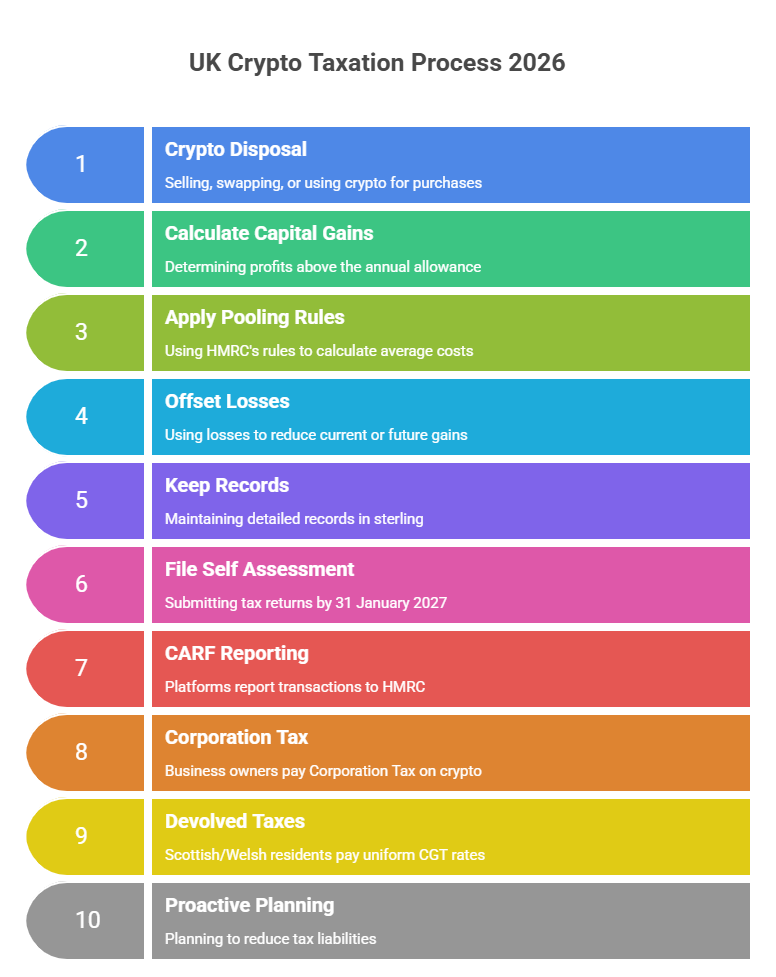
Summary of Key Points
Crypto disposals in the UK trigger Capital Gains Tax on profits above the £3,000 annual allowance for 2025/26, with rates at 18% for basic-rate taxpayers and 24% for higher/additional-rate on non-residential assets.
Use HMRC's pooling rules to calculate average costs for identical tokens, applying same-day and 30-day matching first to avoid artificial losses.
Losses can offset current or future gains indefinitely but must be reported via Self Assessment even if no tax is due.
Taxable events include selling, swapping tokens, using for purchases, or gifting (except to spouses or charities).
Keep detailed records in sterling, including fees as deductible costs, as exchanges don't handle pooling for you.
File via Self Assessment by 31 January 2027 for 2025/26, using dedicated crypto boxes, or real-time service for simpler cases.
From 1 January 2026, platforms report transactions to HMRC under CARF, increasing scrutiny on your calculations.
Business owners face Corporation Tax on company-held crypto, without personal allowances.
Scottish/Welsh residents pay uniform CGT rates, but income interactions (e.g., staking rewards) may hit devolved bands.
Proactive planning, like claiming negligible value on worthless tokens or offsetting losses, can significantly reduce liabilities – consult early for complex portfolios.
FAQs
Q1: What happens if I receive cryptocurrency as a gift from a family member outside the UK?
A1: Well, it's worth noting that gifts of crypto can sometimes trigger unexpected tax implications, especially with international elements. In my experience with clients, if the gift is from a non-spouse and exceeds certain values, you might face Inheritance Tax down the line, but for immediate purposes, the acquisition cost becomes your base for future CGT calculations. Consider a client in Leeds who got Bitcoin from an overseas uncle – we had to verify no hidden income tax if it stemmed from business dealings, and convert values to sterling at receipt. Always document the fair market value on the day to avoid disputes later.
Q2: How is tax handled for cryptocurrency airdrops that I didn't request?
A2: In my years advising, unsolicited airdrops often surprise people with their tax bite. They're typically treated as miscellaneous income at market value on receipt, taxed at your income rate – up to 45% for higher earners. Then, any later sale hits CGT. I've seen a Manchester trader overlook this on a minor token drop, leading to a small but nagging underpayment. The key is tracking receipt dates meticulously; if worthless, claim negligible value relief to offset potential gains elsewhere.
Q3: Does Scottish residency change how crypto gains are taxed compared to England?
A3: Ah, the devolved tax quirks – Scotland's income bands differ, but CGT on crypto remains UK-wide at 18% or 24%. However, if your crypto activity counts as income (like frequent trading), Scottish rates up to 48% apply. A client from Edinburgh tripped up here when staking rewards pushed his total into the intermediate band; we adjusted by separating pure CGT disposals. It's simpler than it sounds, but double-check your residency status for the tax year.
Q4: Can crypto losses be used to offset against salary income from my job?
A4: None of us likes losses, but they're not as flexible as you'd hope. Crypto losses offset only against future crypto or other CGT gains, not income tax on wages. I've advised PAYE employees who've carried forward losses for years, turning them into shields during bull markets. For instance, a London office worker with a bad altcoin bet saved thousands by applying it to later Ethereum profits – just ensure you claim them formally in Self Assessment.
Q5: What tax rules apply to buying and selling NFTs in the UK?
A5: NFTs add a creative twist to crypto tax, treated like unique assets with CGT on disposals. Royalties from sales might count as income, though. In my practice, a graphic artist client in Bristol sold her collection and we deducted creation costs as allowable expenses, slashing her bill. Be wary of high-volume flipping – it could flip to trading income, attracting NI too. Start by valuing each at mint or purchase.
Q6: How do I tax interest earned from lending crypto on DeFi platforms?
A6: DeFi lending often feels like free money until tax time. Rewards are income at receipt value, then CGT on token disposals. A self-employed developer I know in Cambridge lent USDT and faced double taxation without proper records. The trick is logging accrual dates and using consistent exchange rates – tools like yield trackers help, but always convert to GBP for HMRC.
Q7: If I mine crypto just as a hobby, do I still need to pay tax?
A7: Hobby mining can sneak into tax territory if it generates value. Small-scale? Often negligible, but rewards are income if systematic. I've helped a hobbyist in Sheffield who scaled up accidentally; we classified it as miscellaneous income, deducting electricity costs. If outputs exceed £1,000 annually, report it – otherwise, it might stay under the trading allowance radar.
Q8: How does a limited company tax crypto held as part of its treasury?
A8: For businesses, crypto in reserves falls under Corporation Tax on gains, no personal allowance. Rates hit 25% for profits over £250,000. A startup director client in Birmingham held Bitcoin for hedging; we treated disposals as chargeable events, offsetting against business losses. Key advice: Keep separate wallets and prove it's not personal to avoid benefit-in-kind charges.
Q9: What impact do the new 2026 crypto reporting rules have on my filings?
A9: The CARF rules from January 2026 mean platforms share your data with HMRC, flagging mismatches faster. It doesn't change calculations but ups scrutiny. In my experience, clients with messy records faced enquiries pre-emptively; one avoided penalties by reconciling early. Focus on accurate self-reporting – it's your defence against automated nudges.
Q10: What if I've got undeclared crypto gains from previous years?
A10: It's a common mix-up, but voluntary disclosure is your best bet to minimise penalties. HMRC's Worldwide Disclosure Facility covers crypto; penalties can drop to 0% if reasonable care was taken. A retailer client in Liverpool came clean on 2023 trades – we backdated calculations, saving him from 200% fines. Act soon, as data sharing ramps up.
About the Author

Maz Zaheer, AFA, MAAT, MBA, is the CEO and Chief Accountant of MTA and Total Tax Accountants, two premier UK tax advisory firms. With over 15 years of expertise in UK taxation, Maz provides authoritative guidance to individuals, SMEs, and corporations on complex tax issues. As a Tax Accountant and an accomplished tax writer, he is renowned for breaking down intricate tax concepts into clear, accessible content. His insights equip UK taxpayers with the knowledge and confidence to manage their financial obligations effectively.
Disclaimer:
The information provided in our articles is for general informational purposes only and is not intended as professional advice. While we strive to keep the information up-to-date and correct, MTA makes no representations or warranties of any kind, express or implied, about the completeness, accuracy, reliability, suitability, or availability with respect to the website or the information, products, services, or related graphics contained in the articles for any purpose. Any reliance you place on such information is therefore strictly at your own risk. The graphs may also not be 100% reliable.
We encourage all readers to consult with a qualified professional before making any decisions based on the information provided. The tax and accounting rules in the UK are subject to change and can vary depending on individual circumstances. Therefore, MTA cannot be held liable for any errors, omissions, or inaccuracies published. The firm is not responsible for any losses, injuries, or damages arising from the display or use of this information.


